

When I posed this question to my students in the past, two of them answered me. The first student’s answer was “To change my mind and make it more peaceful.” The second student said, “To save all sentient beings and liberate them.”
The first answer is the Hinayana level of answer: it stems from the wish for my mind to be at peace, this is not wrong, the second answer is the Mahayana level: to want liberation for all sentient beings. This is better but still it is not good enough, the best answer is that the reason for practicing Dharma is to become enlightened ourselves and become Buddha, for only when you are a Buddha can you help sentient beings in many, many ways.
If you do not want to become Buddha, why practice Dharma? Can you help all sentient beings at this point in time? No, not possible! However, while you may not be able to help all, you could help some; and if you cannot help some, you could still help one sentient being, right? At least, while walking on the road filled with ants crawling on the floor, you do not step on them on purpose and kill them, Instead, when you see ants, you avoid stepping on them, this is practicing Dharma. You cherish others, regardless of whether it is an ant, a fish or a human being. That is the purpose of practicing Dharma.
Practicing Dharma equates to getting enlightened which equals cherishing others. If you could cherish others so much, when you encounter problems, you do not see them as problems, if you could see that you are the only person as compared to so many ·other sentient beings, then when you yourself suffer, you think ‘It’s OK! I’m only one person! Others are innumerable!” Trust me, if you have this kind of mind, you will not suffer because negative conditions will not come to you, Look at all the past masters. For instance, while Lama Serlingpa, who was Atisha’s teacher, prayed out of his great compassion to be reborn in hell for all sentient beings, he was not reborn in hell! Instead, he kept returning to the human realm as great Buddhist saints!
So once again, there is no immediate solution when others seem to make things difficult for you. The only way out is you must have Bodhicitta, which is the key to the door of happiness. Bodhicitta also locks out suffering. It is also the best sports shoes you could find! With it, you can walk and run in any difficult situation. So, you must develop Bodhicitta. Otherwise, it is not possible for your practice to develop. Whatever you do is meaningless without it.
From the very start, you must strongly arouse the wish to be more mindful and work towards it rather than regret your lack of mindfulness after you have become angry or after some emotional outburst. So, if you were to tell me that you could not be more mindful and could not manage to notice when you were just about to get angry, I would tell you that your excuse is lousy! That is why I said that this is the answer you would not like to hear! You did not put in enough effort! Frankly how many of you think about Bodhicitta every day? Even if you do, do you spend enough time on it, or do you also just maintain your same level of Bodhicitta every day? If you never try to improve your bodhichilta, then it is like that is everything is flat, zero! You get contented with your level of development and not try to improve anymore. If you continue this way until you die, you will not see any improvement in your mind, be it trying to improve your mindfulness or love. You have never tried to think of how to integrate your spiritual meditations into your daily life, only thinking superficially in your mind “Oh I want to develop Bodhicitta, to benefit others … blah blah blah” but you have never tried to think about HOW to benefit other sentient beings!
If a beggar on the street asked me for money, should I give money? Yes, right? So in the same way, we thought about Bodhicitta and what it was all about, but we did not prepare ourselves on how to react to situations. We must mentally prepare ourselves and consider all the possibilities that could happen. If someone were to upset me, how should I react? If someone scolds me, am I ready to show patience instead?
Therefore, Bodhicitta is the best because Bodhicitta works not only for this present life or future lives, it will help us all the way to enlightenment. Now there are going to be one thousand Buddhas in this eon. You all can strive to become these Buddhas. Really! It is only a matter whether you want to or not.
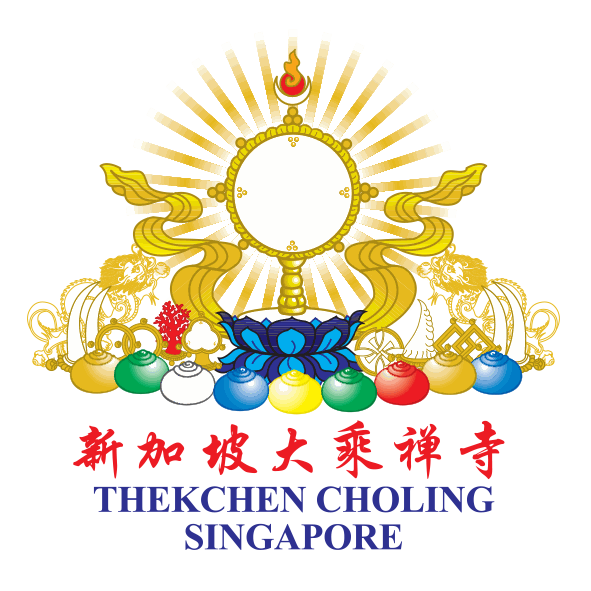
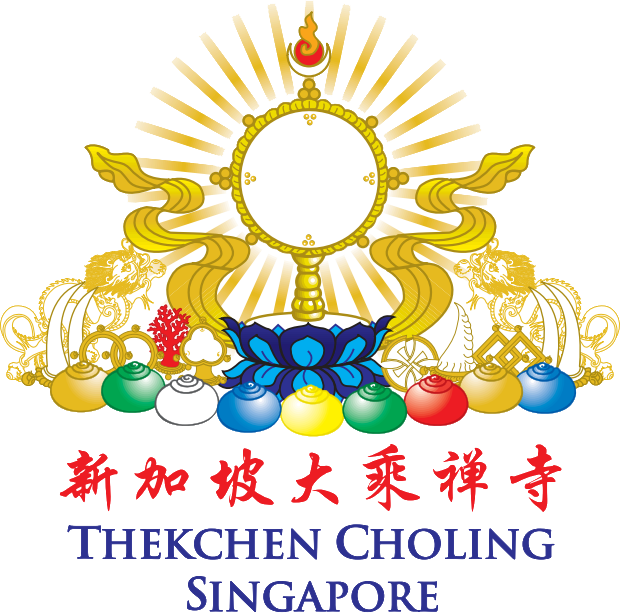
Sacred Mirror
The Sacred Mirror represents consciousness and the element of space. Clear, pure and bright, the mirror reflects all phenomena objectively without bias, thereby reminding us to practice objectivity and to rise above our judgmental minds. On a more subtle level, it reflects the Buddha’s core teaching of emptiness – that nothing exists on its own side without a dependent arising cause.
Pinnacle of the mirror
The pinnacle of the mirror, formed by the white crescent moon, flaming red sun and an orange flame of fire, represents the completion stage of Vajrayana practice.
Light Rays
The light rays radiating from the Sacred Mirror represent the flourishing of the Buddha’s teachings, fanning out to the furthest reaches of the universe.
Full Moon Disc
The moon disc represents Bodhicitta, the aspiration to become a Buddha to benefit all sentient beings.
Blue Lotus
Divinely fragrant, blue lotuses bloomed only in the Buddha’s time. By incorporating it into the temple’s logo, it is symbolic of the ever-present Buddha in Thekchen Choling. Moreover, a lotus flower represents purity, perfection, compassion and renunciation, similar to how the beautiful lotus remains untainted even though it had arisen out from the muddy waters.
Nine Precious Jewels
These nine precious jewels represent the Guru, Buddha, Dharma, Sangha, yidam or mind-seal deity, Dharma protector, the sky, earth, and the human realm.
Two Dragons
The two dragons represent continuity and harmony and create the cause for the temple to enjoy the strong support of members and benefactors for Dharma to flourish.
Golden Khata
The flowing golden khata represents the auspicious increase of all Dharma activities.
The Seven Gems of the Chakravartin or a Wheel-Turning King
1. The precious horse represented by a unicorn’s horn
2. The precious elephant represented by its tusks
3. The precious queen represented by round golden earrings
4. The precious minister represented by square golden earrings
5. The precious general represented by a pair of crossed swords
6. The precious jewel represented by the triple-eyed gem
7. The precious Dharma wheel represented by a branch of coral