

“With modern technology, particularly with social media, we sometimes give ourselves so much unnecessary stress by keeping ourselves overly busy with everything.”
Our purpose as spiritual beings on the path to enlightenment is to understand if we have decided to become a Buddha for the benefit of all sentient beings. Many have taken refuge and have received Bodhisattva and Tantric vows, but their lives have not changed very much. Their lives are still very worldly.
As a practitioner, we must always relook at our original motive. Also, look at the things around us that we have taken for granted and see them the way they are without adding any labels or emotion.
When ordinary beings come together, what starts as communication turns into judgment and ends up about who is right. As dharma practitioners, we should practice and train to become like the boundless heart of the Buddha. Rather than ask “who is right,” we should be asking ourselves, “what is right,” knowing that everybody has different conditions.
When we look at the Buddha, we can see that he maintains seeing the emptiness in all things and manifesting dignity. On the other hand, we are all trained very well for efficiency, but how many of us can uphold dignity? Dignity comes from self-confidence. We can see how a person with a dignified presence can walk into a room and somehow – only by being there – makes everyone feel like everything will be okay. It comes from inner confidence. We must trust the law of cause and effect, have faith in our prayers, and belief in our practice. Then there will be dignity.
Often we won’t listen to our Guru’s advice due to our ignorance and ego. It is not related to dignity or confidence. What will change us into dignified practitioners are resilience and grit.
The mind continuously goes up and down when it gets disturbed. Things happen beyond our control, and then they can go haywire. But we must have the resilience to never give up on our practice. So cultivate your practice with strength and discipline. Keep your vows because that is something that money cannot buy. And once you do, you can rejoice with the confidence and dignity in knowing that you did it!
Keeping our word, keeping our promise, and keeping our vows is so unbelievable. Likewise, taming our mind and offering our mandala of body, speech, and mind. We need to accumulate these merits, or nothing will happen.
So, is striving for success an ego-trip? It depends upon whether what you are seeking is just for yourself, or it is also for others’ benefit. Success as a Bodhisattva arises only through the path of merit, on which one walks with egoless dignity.
Dharma teaching by Singha Rinpoche and Edited by Sandeep Nath
27 Dec 2020
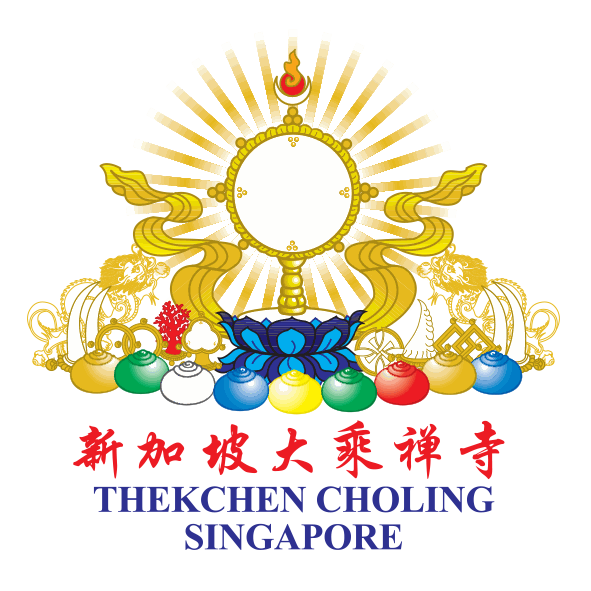
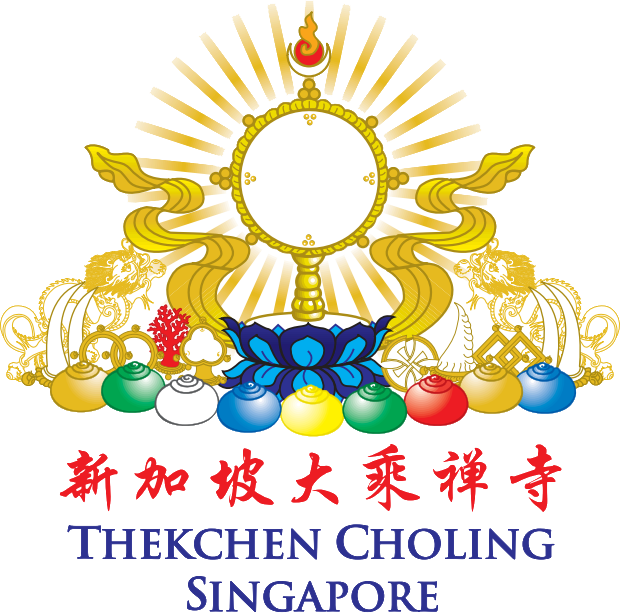
Sacred Mirror
The Sacred Mirror represents consciousness and the element of space. Clear, pure and bright, the mirror reflects all phenomena objectively without bias, thereby reminding us to practice objectivity and to rise above our judgmental minds. On a more subtle level, it reflects the Buddha’s core teaching of emptiness – that nothing exists on its own side without a dependent arising cause.
Pinnacle of the mirror
The pinnacle of the mirror, formed by the white crescent moon, flaming red sun and an orange flame of fire, represents the completion stage of Vajrayana practice.
Light Rays
The light rays radiating from the Sacred Mirror represent the flourishing of the Buddha’s teachings, fanning out to the furthest reaches of the universe.
Full Moon Disc
The moon disc represents Bodhicitta, the aspiration to become a Buddha to benefit all sentient beings.
Blue Lotus
Divinely fragrant, blue lotuses bloomed only in the Buddha’s time. By incorporating it into the temple’s logo, it is symbolic of the ever-present Buddha in Thekchen Choling. Moreover, a lotus flower represents purity, perfection, compassion and renunciation, similar to how the beautiful lotus remains untainted even though it had arisen out from the muddy waters.
Nine Precious Jewels
These nine precious jewels represent the Guru, Buddha, Dharma, Sangha, yidam or mind-seal deity, Dharma protector, the sky, earth, and the human realm.
Two Dragons
The two dragons represent continuity and harmony and create the cause for the temple to enjoy the strong support of members and benefactors for Dharma to flourish.
Golden Khata
The flowing golden khata represents the auspicious increase of all Dharma activities.
The Seven Gems of the Chakravartin or a Wheel-Turning King
1. The precious horse represented by a unicorn’s horn
2. The precious elephant represented by its tusks
3. The precious queen represented by round golden earrings
4. The precious minister represented by square golden earrings
5. The precious general represented by a pair of crossed swords
6. The precious jewel represented by the triple-eyed gem
7. The precious Dharma wheel represented by a branch of coral