“May all beings be free from suffering and its causes.”
As 2020 draws to a close, we might recall it as a year with many names. COVID year. Black lives year. The year of riots, earthquakes, tornados, fires, and uncertainty. Around the world, we have experienced so much suffering. We need to think about how we are living our lives and then ask ourselves if it’s worth it.
Through all of this suffering, can we, however, see the importance and the preciousness of the Buddha’s teachings on loving-kindness, compassion, and understanding?
Think of it this way. Can the suffering we are experiencing help us generate a motivation to be free from this cycle of birth and death and to go towards enlightenment for the sake of liberating all sentient beings from their suffering?
If so, now is a time where The Four Immeasurables are very important.
We are always thinking about our suffering, yet we don’t often think about the causes of this suffering. All suffering and all happiness need to have a cause. So what is the cause for so much suffering? According to the Lam Rim, other texts, and Lama Zopa Rinpoche, the cause of all suffering is self-cherishing. Self-cherishing is based on fear, so how do we free ourselves from this fear? We need wisdom. You light the fire of wisdom in your heart. And to awaken wisdom, we must accumulate merit for this wisdom to arise.
We need to pray and to focus on how to overcome our ignorance. We know that without light, it’s always going to be there. We cannot do everything alone so what’s most important is our coming together as a community in loving-kindness, forgiveness, and mutual support for the benefit of this life and future lives.
We are all ‘feeling, emotional beings’ as we are in samsara. By doing prayers, accumulating merit, and reflecting upon the daily happenings in the world and our own lives, we can understand that our personal problems are so ridiculously small. That is why it is so important to think about the purpose of our life. Is it just about fulfilling our own wants and dreams? What does your life mean for you and others? Does it serve a greater good?
These words are a beautiful wish for all beings, so we should all think about them, The Four Immeasurables, every day. In the beginning, maybe it’s just reciting the words. But after a while, there comes the feeling. When we develop loving-kindness and say these words in our minds and prayers, it helps.
Dharma Teaching by Singha Rinpoche and Edited by Sandeep Nath
15 Nov 2020
Sacred Mirror
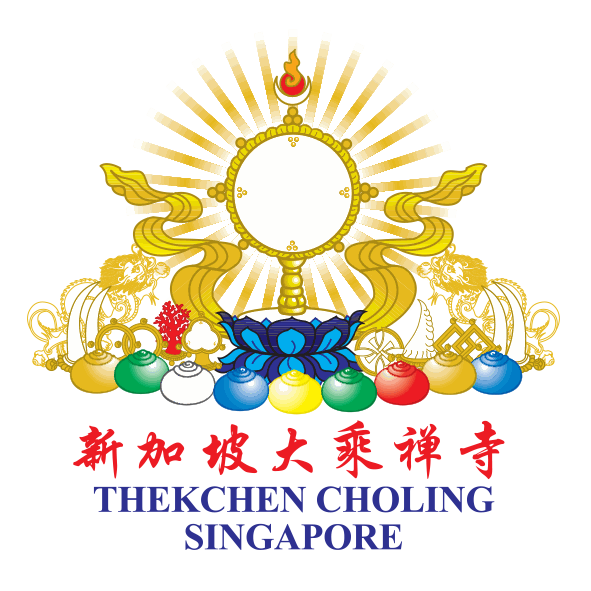
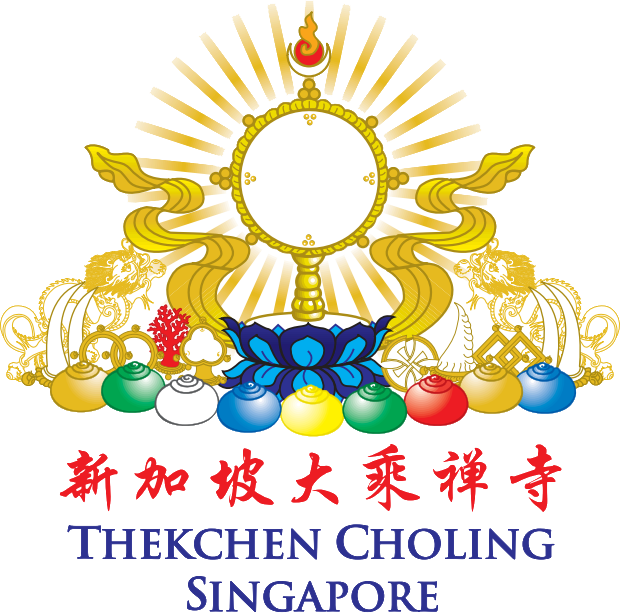
The Sacred Mirror represents consciousness and the element of space. Clear, pure and bright, the mirror reflects all phenomena objectively without bias, thereby reminding us to practice objectivity and to rise above our judgmental minds. On a more subtle level, it reflects the Buddha’s core teaching of emptiness – that nothing exists on its own side without a dependent arising cause.
Pinnacle of the mirror
The pinnacle of the mirror, formed by the white crescent moon, flaming red sun and an orange flame of fire, represents the completion stage of Vajrayana practice.
Light Rays
The light rays radiating from the Sacred Mirror represent the flourishing of the Buddha’s teachings, fanning out to the furthest reaches of the universe.
Full Moon Disc
The moon disc represents Bodhicitta, the aspiration to become a Buddha to benefit all sentient beings.
Blue Lotus
Divinely fragrant, blue lotuses bloomed only in the Buddha’s time. By incorporating it into the temple’s logo, it is symbolic of the ever-present Buddha in Thekchen Choling. Moreover, a lotus flower represents purity, perfection, compassion and renunciation, similar to how the beautiful lotus remains untainted even though it had arisen out from the muddy waters.
Nine Precious Jewels
These nine precious jewels represent the Guru, Buddha, Dharma, Sangha, yidam or mind-seal deity, Dharma protector, the sky, earth, and the human realm.
Two Dragons
The two dragons represent continuity and harmony and create the cause for the temple to enjoy the strong support of members and benefactors for Dharma to flourish.
Golden Khata
The flowing golden khata represents the auspicious increase of all Dharma activities.
The Seven Gems of the Chakravartin or a Wheel-Turning King
1. The precious horse represented by a unicorn’s horn
2. The precious elephant represented by its tusks
3. The precious queen represented by round golden earrings
4. The precious minister represented by square golden earrings
5. The precious general represented by a pair of crossed swords
6. The precious jewel represented by the triple-eyed gem
7. The precious Dharma wheel represented by a branch of coral