
“We have to accept inconveniences as part of our practice. Doing so is what roughs and rubs off our ego like sandpaper or a sharpening stone.”
If we look at this phenomenon labeled Facebook or the internet, it has got us entrapped. First, it hooks us, and then it drowns us. It’s a samsaric materialism. That’s why we need to have at least a basic understanding of emptiness and dependent arising. It’s important because otherwise, we will become totally egoistic. But on the other extreme, having only a spiritual or religious practice as the only focal point in your life is spiritual materialism. So there must always be a balance.
When we do anything, we always tend to use the methods that work best for us. We have gotten used to specific ways of doing things and have become comfortable doing something in that particular way. But if you want to practice dharma, you have to start doing things that don’t always make your life comfortable.
Think about living your life as if you are a small enterprise. You are the boss, but you are also the delivery man, the service provider, the front line person. You do the cleaning, take out the trash, and everything else. So there is no set aspect of what you are. Similarly, when we come together to work, we all must be free of our mental dispositions of who we are or who we think we must be. Many of us only want to like what we like. We feel that this is good and that it’s normal, but it’s not. These are the things that won’t kill us, but they will strangle us. We need to stop practicing this selfish ideology and renounce it. When you do, you are ready to offer anything and everything for the service of all beings and offer body, speech, and mind to Buddha, Dharma, Sangha. Otherwise, you are only creating more samsaric materialism.
Facing the mind is when you come to see yourself and how you can overcome yourself. It isn’t easy. You can quickly become tired because of your ego. But don’t give up. You have to become a real hero or heroine, a Warrior. We will get thrown off course by other people’s ideas of what’s right and wrong. These situations will always be there, but we should continue to cultivate and practice growing. Start to release everything. Offer your heart. And your mind. Communicate with skillful means. Skillfulness is a method of cultivation to connect with all beings. It’s the cultivation of the activity of the body, speech, and mind of praise. Skillfulness lies in helping and supporting one another and coming together meaningfully with a common goal even though everybody may have a different viewpoint.
A peaceful warrior adopts these skillful means. Internalizes interdependence and keeps ego under check with balance at all times.
Dharma Teaching by Singha Rinpoche and Edited by Sandeep Nath
25 October 2020
Sacred Mirror
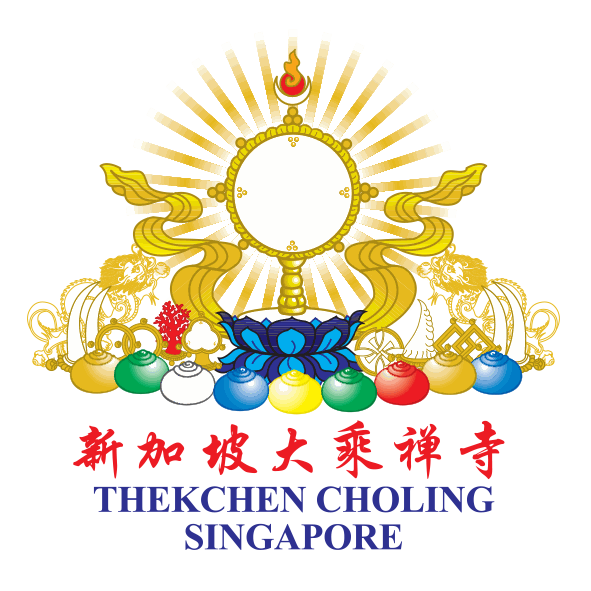
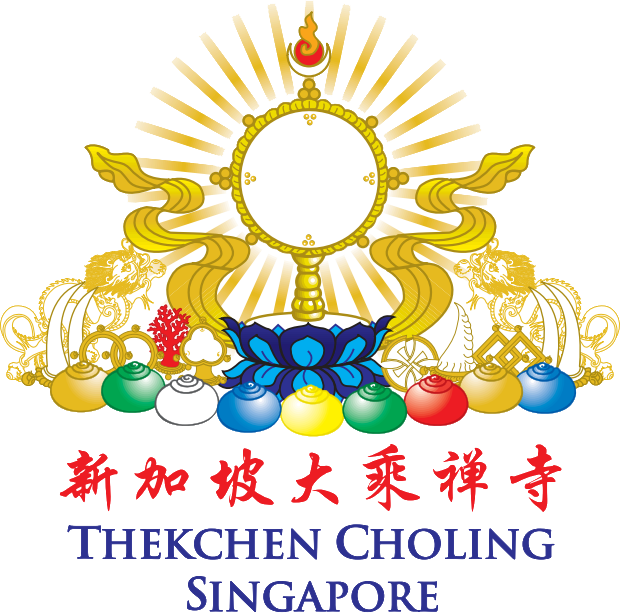
The Sacred Mirror represents consciousness and the element of space. Clear, pure and bright, the mirror reflects all phenomena objectively without bias, thereby reminding us to practice objectivity and to rise above our judgmental minds. On a more subtle level, it reflects the Buddha’s core teaching of emptiness – that nothing exists on its own side without a dependent arising cause.
Pinnacle of the mirror
The pinnacle of the mirror, formed by the white crescent moon, flaming red sun and an orange flame of fire, represents the completion stage of Vajrayana practice.
Light Rays
The light rays radiating from the Sacred Mirror represent the flourishing of the Buddha’s teachings, fanning out to the furthest reaches of the universe.
Full Moon Disc
The moon disc represents Bodhicitta, the aspiration to become a Buddha to benefit all sentient beings.
Blue Lotus
Divinely fragrant, blue lotuses bloomed only in the Buddha’s time. By incorporating it into the temple’s logo, it is symbolic of the ever-present Buddha in Thekchen Choling. Moreover, a lotus flower represents purity, perfection, compassion and renunciation, similar to how the beautiful lotus remains untainted even though it had arisen out from the muddy waters.
Nine Precious Jewels
These nine precious jewels represent the Guru, Buddha, Dharma, Sangha, yidam or mind-seal deity, Dharma protector, the sky, earth, and the human realm.
Two Dragons
The two dragons represent continuity and harmony and create the cause for the temple to enjoy the strong support of members and benefactors for Dharma to flourish.
Golden Khata
The flowing golden khata represents the auspicious increase of all Dharma activities.
The Seven Gems of the Chakravartin or a Wheel-Turning King
1. The precious horse represented by a unicorn’s horn
2. The precious elephant represented by its tusks
3. The precious queen represented by round golden earrings
4. The precious minister represented by square golden earrings
5. The precious general represented by a pair of crossed swords
6. The precious jewel represented by the triple-eyed gem
7. The precious Dharma wheel represented by a branch of coral