
“This article presents a few answers Singha Rinpoche provided for questions about reincarnation, illness, and failure.”
Reincarnation
The purpose of being Buddhist is to liberate oneself from the six realms of samsara. When we learn about the six realms, we understand that there is reincarnation. If we cannot accept that, we forget the real purpose of Buddhism. All we do then is pray to have a good existence while remaining in samsara. We pray to have all kinds of worldly possessions. While we may accumulate merit, it isn’t Buddhist philosophy when we dedicate it to our material desires. The Buddha did say that if we do things with dharma intent, dharma action, and dharma dedication, worldly benefits will come as a side effect. But without the acceptance of reincarnation, we merely remain focused upon the side effects.
Illness (responding to a cancer survivor)
If you have had cancer, it is because there was a cause for it. So first, you must purify the cause. When something will happen, and we want to stop it, we need to generate an incredible amount of merit to counter it. For example, if there is a guided missile coming toward us, we must have an equally powerful guided missile to stop it.
We pray that all beings not be afflicted by cancer or by any sickness. But we also need to take significant responsibility and generous action to counter it. The ideal step we can take is the development and generation and actual cultivation practice of bodhicitta. We accept that we have made mistakes, and we want to correct them. We don’t want to run away and cower. We all have fears. That’s why we use our situations to see how much samsara sucks. It’s not to say that we cannot have fun, but we must not forget that our life’s primary purpose is to gain enlightenment while we are in samsara. The Buddha said, “I cannot wash away your sins or take away your sickness or pain, but if you have faith and devotion to the words of truth, then we can walk together, and we can support one another.”
Failure (responding to the questioner’s loss of confidence)
Perhaps you have squandered your good worldly karma. But life itself is about ups and downs. When things go wrong, how do you evolve? How do you change?
That’s why the Buddha’s teachings on impermanence are a wake-up call for each one of us. We must change. We must evolve and strive to gain merit. With that, we will have success.
When we have any small success, we must generate good karma. Share what we have and humbly accept other people’s criticisms of us. We must offer service, our heart, and our support. Work with other people to improve our minds and lives. Confidence will emerge from mind training and study about the impermanence of phenomena. With that, we will respond to different situations more skillfully.
Dharma Teaching by Singha Rinpoche and edited by Sandeep Nath
21 Mar 2021
Sacred Mirror
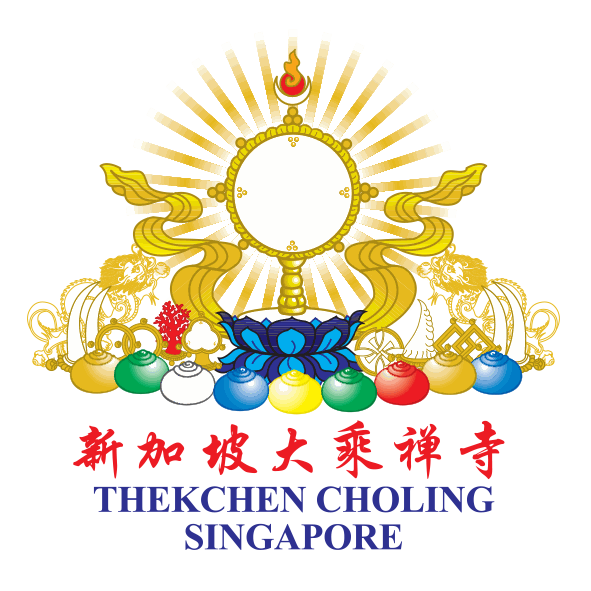
The Sacred Mirror represents consciousness and the element of space. Clear, pure and bright, the mirror reflects all phenomena objectively without bias, thereby reminding us to practice objectivity and to rise above our judgmental minds. On a more subtle level, it reflects the Buddha’s core teaching of emptiness – that nothing exists on its own side without a dependent arising cause.
Pinnacle of the mirror
The pinnacle of the mirror, formed by the white crescent moon, flaming red sun and an orange flame of fire, represents the completion stage of Vajrayana practice.
Light Rays
The light rays radiating from the Sacred Mirror represent the flourishing of the Buddha’s teachings, fanning out to the furthest reaches of the universe.
Full Moon Disc
The moon disc represents Bodhicitta, the aspiration to become a Buddha to benefit all sentient beings.
Blue Lotus
Divinely fragrant, blue lotuses bloomed only in the Buddha’s time. By incorporating it into the temple’s logo, it is symbolic of the ever-present Buddha in Thekchen Choling. Moreover, a lotus flower represents purity, perfection, compassion and renunciation, similar to how the beautiful lotus remains untainted even though it had arisen out from the muddy waters.
Nine Precious Jewels
These nine precious jewels represent the Guru, Buddha, Dharma, Sangha, yidam or mind-seal deity, Dharma protector, the sky, earth, and the human realm.
Two Dragons
The two dragons represent continuity and harmony and create the cause for the temple to enjoy the strong support of members and benefactors for Dharma to flourish.
Golden Khata
The flowing golden khata represents the auspicious increase of all Dharma activities.
The Seven Gems of the Chakravartin or a Wheel-Turning King
1. The precious horse represented by a unicorn’s horn
2. The precious elephant represented by its tusks
3. The precious queen represented by round golden earrings
4. The precious minister represented by square golden earrings
5. The precious general represented by a pair of crossed swords
6. The precious jewel represented by the triple-eyed gem
7. The precious Dharma wheel represented by a branch of coral