
We all have the ambition to live a comfortable, happy life, and so we put in effort in our studies, careers, business, relationships and so on. This ambition is typically married with the intent to have a good job or successful business, a spouse or partner and comfort in terms of a nice house and car, holidays in enjoyable places and so on. Singha Rinpoche has often said that we tend to put in a lot of effort, make sacrifices and do whatever we deem necessary to fulfil our ambitions as we pursue the happiness and pleasures of this life. However, for dharma practice, ambition is typically not as great for most people – certainly not for me.
However, I did have one experience – which I ascribe to the Guru’s blessing – which left a deep imprint in my mind; the impression of the need to practice the Buddhadharma. I will recount it here in case it might benefit others.
In 2003, Dagri Rinpoche was in Singapore and Singha Rinpoche called a few students to his room and told us we were to receive an initiation from Dagri Rinpoche. It would entail four days of teachings at night prior to the initiation. I had taken refuge in 1999 and this suddenly felt like things were “moving too fast”. I also had numerous reasons – activities at the temple took up time, a four-year-old daughter and a second child on the way, work… – in other words I was busy (or lazy). I tried to request for Rinpoche to excuse me, that I did not wish to receive this initiation (mainly as it would likely require more teachings and daily commitment). Over the next few days, I tried unsuccessfully to find ways to have Rinpoche excuse me from the initiation.
The day of the initiation arrived and I drove along the highway, intent on telling Rinpoche that I did not wish to receive the initiation. While driving, a vision suddenly appeared to me that was frighteningly clear. In the vision I had, my maternal grandfather who had died many years ago was screaming in pain surrounded by what I can only describe as a red atmosphere. Around him, others were also screaming and in pain but I could not see exactly who. This shocked me. I began to cry – violent, uncontrollable sobbing with tears to the point I could hardly see the road. I grappled with so many emotions, sadness at the suffering I saw, troubled by the decision before me, guilt …..so many emotions. All the way from Braddell to Bukit Timah, the tears fell uncontrollably.
As I neared the centre, suddenly, all my conflicted feelings resolved themselves. I remembered the teachings on compassion and Rinpoche saying “if your most darling child were walking toward a cliff what would you do?” I was filled with guilt and shame at thinking that I should only practice when convenient. Could I really alleviate their suffering just by receiving an initiation? I did not know, but to do nothing and avoid making any effort because I was “busy” felt heartless.
I arrived at the centre and realised I had to receive the initiation. Dharma practice was not something I could pick and choose to do when convenient. I have no idea why that vision occurred; I ascribe it as a blessing from my Guru to wake me up.
I wish I could say that this experience completely transformed my life and I became some serious dharma practitioner receiving lots of initiations and engaging in a lot of practice etc; but, despite this experience, I still have been easily satisfied with my so-called dharma practice, pursuing it when convenient and to be honest – mostly overtaken by concerns of this life.
Joyous effort or as I refer to it, Dharma ambition – the drive to practice the dharma even when “difficult, inconvenient”, resulting in stress or sacrifice and the drive to never feel that I am “satisfied” with my dharma practice for the benefit of all beings – remains very much a work in progress. Typically, if my own life is comfortable with no great loss or a serious illness, it feels like there is often not as much ambition to practice. I pray that we all get to the point where dharma practice is done with the greatest joy for the benefit of others, no matter how seemingly inconvenient or difficult.
This is the final piece I wish to write for this blog. At least for now. It may perhaps be timely for some of you to also begin adding your experiences. For those who took the time to read these musings, my thanks. If any of this has been of benefit to you, it is only due to the blessings of Guru and Triple Gem and not any skill on my part. I dedicate any merits created to the long lives of our Precious Gurus and the flourishing of the Buddhadharma.
May all be auspicious.
Tenzin
23 Jan 2022
Sacred Mirror
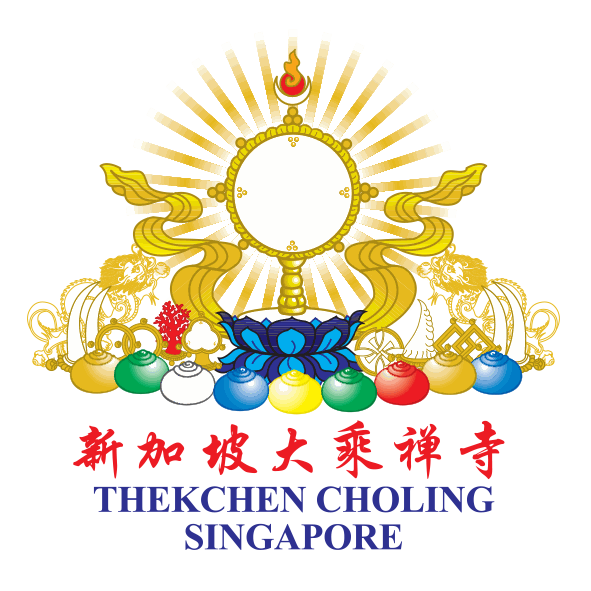
The Sacred Mirror represents consciousness and the element of space. Clear, pure and bright, the mirror reflects all phenomena objectively without bias, thereby reminding us to practice objectivity and to rise above our judgmental minds. On a more subtle level, it reflects the Buddha’s core teaching of emptiness – that nothing exists on its own side without a dependent arising cause.
Pinnacle of the mirror
The pinnacle of the mirror, formed by the white crescent moon, flaming red sun and an orange flame of fire, represents the completion stage of Vajrayana practice.
Light Rays
The light rays radiating from the Sacred Mirror represent the flourishing of the Buddha’s teachings, fanning out to the furthest reaches of the universe.
Full Moon Disc
The moon disc represents Bodhicitta, the aspiration to become a Buddha to benefit all sentient beings.
Blue Lotus
Divinely fragrant, blue lotuses bloomed only in the Buddha’s time. By incorporating it into the temple’s logo, it is symbolic of the ever-present Buddha in Thekchen Choling. Moreover, a lotus flower represents purity, perfection, compassion and renunciation, similar to how the beautiful lotus remains untainted even though it had arisen out from the muddy waters.
Nine Precious Jewels
These nine precious jewels represent the Guru, Buddha, Dharma, Sangha, yidam or mind-seal deity, Dharma protector, the sky, earth, and the human realm.
Two Dragons
The two dragons represent continuity and harmony and create the cause for the temple to enjoy the strong support of members and benefactors for Dharma to flourish.
Golden Khata
The flowing golden khata represents the auspicious increase of all Dharma activities.
The Seven Gems of the Chakravartin or a Wheel-Turning King
1. The precious horse represented by a unicorn’s horn
2. The precious elephant represented by its tusks
3. The precious queen represented by round golden earrings
4. The precious minister represented by square golden earrings
5. The precious general represented by a pair of crossed swords
6. The precious jewel represented by the triple-eyed gem
7. The precious Dharma wheel represented by a branch of coral