In modern day communication training, we are told to be clear and concise. We use various means to check whether the person we have communicated with has understood our message etc. Over the years, I have realized that this expectation of communication that we, as a listener, often have does not apply to conversation with our Gurus. Does that mean they are not clear and concise? No, they are – but our interpretation of what we think we have heard them, makes a difference.
The Catuḥpratiśaraṇa Sūtra states (of the Four Reliances): –
Rely on the message of the teacher, not on his personality
Rely on the meaning, not just on the words
Rely on the real meaning, not on the provisional one
Rely on your wisdom mind, not on your ordinary, judgemental mind
Rinpoche communicates in many ways, sometimes with silence as Buddha did, sometimes saying something to one person but in fact the message may be intended for someone else who is present. When people come to Rinpoche for advice, the interpretation of what he said and really meant often differs based on what others perceive. This can sometimes lead to misunderstanding as illustrated below.
A relative had been diagnosed with Multiple Sclerosis. This is a degenerative nerve disease and can either last for some time or can lead to death quite quickly. I was requested to bring him and his wife to see Rinpoche. We arrived at the Bukit Timah centre on a Saturday morning when Rinpoche was teaching a meditation class. We consulted Rinpoche and he listened and consoled him. I cannot remember the exact details of whether any pujas were recommended (I think so) but as they kept asking questions about what types of treatments to pursue etc, Rinpoche finally said, “Don’t worry so much, things will be okay in the end.” Rinpoche then asked them to join the meditation class. He instructed me to distribute the King of Prayers for all of us, including my relatives, to recite. I was puzzled. Why recite an aspiration prayer for rebirth in Sukhavati at a meditation class? It then dawned on me that this was Rinpoche’s way of ensuring my relative recited this extremely beneficial prayer at least once, before his passing.
A few days later, someone mentioned to me that our relative had felt better after seeing Rinpoche. She said they were all glad to hear that he would recover based on what Rinpoche said. I was surprised at that, and said, “No, Rinpoche did not say he will recover, just not to worry and that it will be okay in the end. He made the class recite the King of Prayers, and that is most recited as an aspiration for someone who is dying or dead.”
The different interpretations can be seen here: my relatives had taken what Rinpoche said to mean that there was a chance of a miraculous recovery. Yet, I did not hear Rinpoche say “you will recover”.
Faced with knowing quite certainly what was to happen, I felt it was almost impossible for Rinpoche to tell them that death was imminent. My relative passed away less than six months later.
This often happens when people ask Rinpoche for advice. Rinpoche, via either divination or other means, is often well aware of what is likely to happen. He then skilfully has to determine how best to communicate advice to us, we who are hungry to hear what we want to hear. At times, his advice is misunderstood and people have been upset, with some even going to the extent of accusing Rinpoche of lying. To avoid such a situation where we become unhappy with our Guru’s advice, a certain level of trust in the Guru – a conviction of his bodhicitta motivation – has to grow within us first before we utilise the Four Reliances to contemplate his words.
Tenzin
19 Dec 2021
Sacred Mirror
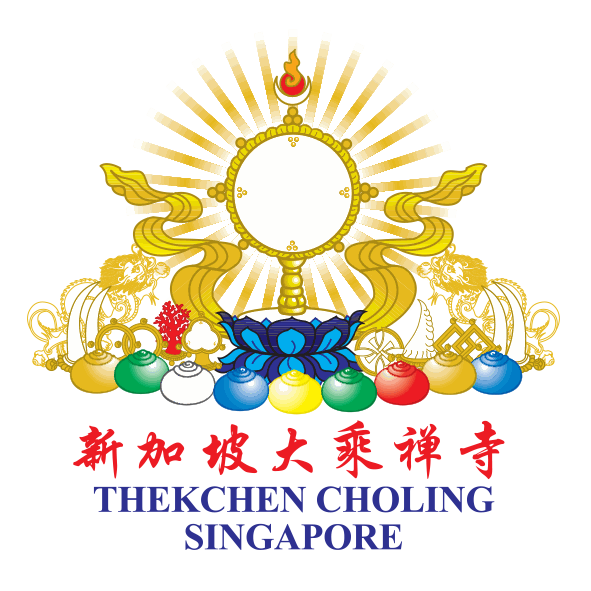
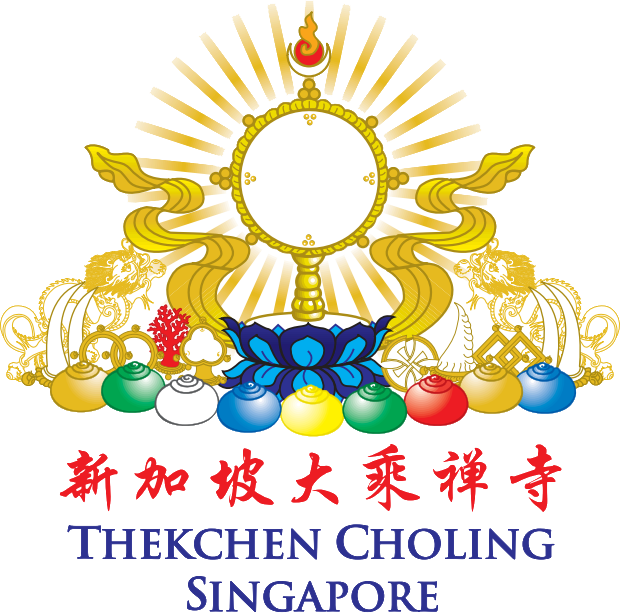
The Sacred Mirror represents consciousness and the element of space. Clear, pure and bright, the mirror reflects all phenomena objectively without bias, thereby reminding us to practice objectivity and to rise above our judgmental minds. On a more subtle level, it reflects the Buddha’s core teaching of emptiness – that nothing exists on its own side without a dependent arising cause.
Pinnacle of the mirror
The pinnacle of the mirror, formed by the white crescent moon, flaming red sun and an orange flame of fire, represents the completion stage of Vajrayana practice.
Light Rays
The light rays radiating from the Sacred Mirror represent the flourishing of the Buddha’s teachings, fanning out to the furthest reaches of the universe.
Full Moon Disc
The moon disc represents Bodhicitta, the aspiration to become a Buddha to benefit all sentient beings.
Blue Lotus
Divinely fragrant, blue lotuses bloomed only in the Buddha’s time. By incorporating it into the temple’s logo, it is symbolic of the ever-present Buddha in Thekchen Choling. Moreover, a lotus flower represents purity, perfection, compassion and renunciation, similar to how the beautiful lotus remains untainted even though it had arisen out from the muddy waters.
Nine Precious Jewels
These nine precious jewels represent the Guru, Buddha, Dharma, Sangha, yidam or mind-seal deity, Dharma protector, the sky, earth, and the human realm.
Two Dragons
The two dragons represent continuity and harmony and create the cause for the temple to enjoy the strong support of members and benefactors for Dharma to flourish.
Golden Khata
The flowing golden khata represents the auspicious increase of all Dharma activities.
The Seven Gems of the Chakravartin or a Wheel-Turning King
1. The precious horse represented by a unicorn’s horn
2. The precious elephant represented by its tusks
3. The precious queen represented by round golden earrings
4. The precious minister represented by square golden earrings
5. The precious general represented by a pair of crossed swords
6. The precious jewel represented by the triple-eyed gem
7. The precious Dharma wheel represented by a branch of coral