“We are all the by-products of what we have chosen to keep in our memories and focus upon… so we become whatever it is that we like or what we don’t like. Samsara can only be stopped by our own changes.”
When we practice meditation, the most important things are detachment, renunciation and having the right view of emptiness. To understand this last one, we need intellectual knowledge about the phenomena of cause, condition, and effect. Emptiness is related with interdependence, and not with the idea that everything is empty, or everything is nothing.
We need to learn how to deconstruct everything that we experience with our five senses. And we can do this by returning everything back to the four elements of water, earth, fire and air. Then everything becomes as it is and we can dwell in the natural sphere of uncomplicatedness. We are able to rest in that uncomplicated emptiness.
There is no need to make things more difficult. Practice to leave things as they are. If you are meditating under a tree, then you are part of that tree. If you are meditating by the riverside, you are part of the riverside. Because you don’t truly exist you are able to be in oneness with nature.
Somehow, we forget that we are all a part of nature. In forgetting this we start to become more and more egoistic, idealistic and conceptualized. The result is a bigger “I” which then makes it impossible for us to do anything because it clouds everything over. And our lives and environs become polluted.
When we meditate, the idea is not to be seeing things. We are training in visualization – not in seeing things. Because when we see, we are only conjuring up things with our egos.
For a Buddhist, it is bad luck to become egoistic. Good luck, in a worldly sense for most of us is when everything is going our way. But when worldly good luck creates ego, that becomes a Buddhist’s bad luck. So, when we are having a good year, we must use the time and the opportunity to make some big break throughs. When we are having a bad year, we don’t just lay low. We must continue to do the good work that improves our karma.
Samsara is like a big playground. There is a lot of anger, jealousy and showing off. Many of us don’t know how to play well together. It’s okay to play with all of our toys here because we must enjoy whatever it is that we have without getting sucked in by all of it.
Buddhism is about awareness. It is not about suffering or pain, happiness or pleasure. We are Buddha nature and so it’s not about self-discovery, rather about unfolding ourselves, peeling back the layers to discover the empty nature of ourselves and that of all beings as the same.
Dharma Teaching by Singha Rinpoche and edited by Sandeep Nath
4 April 2021
Sacred Mirror
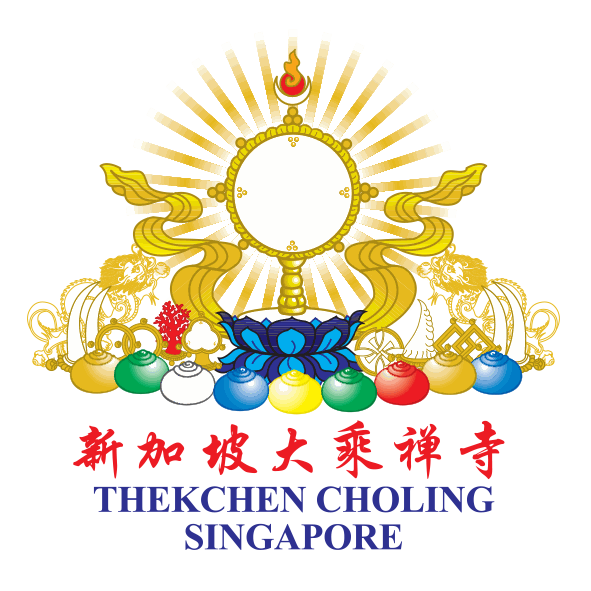
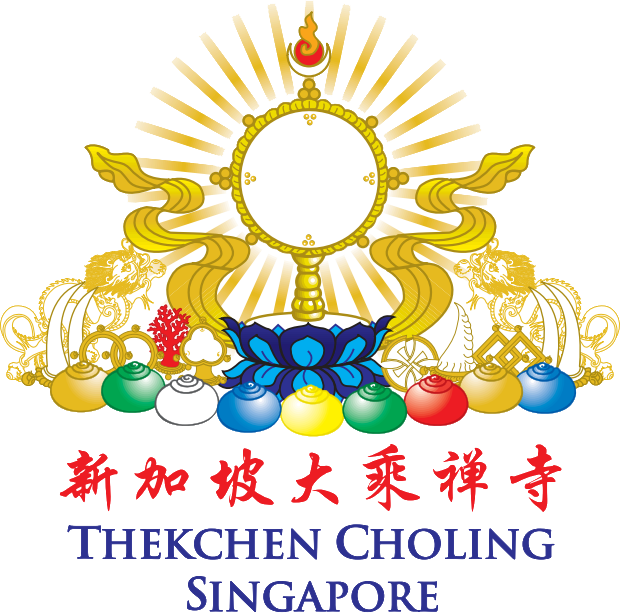
The Sacred Mirror represents consciousness and the element of space. Clear, pure and bright, the mirror reflects all phenomena objectively without bias, thereby reminding us to practice objectivity and to rise above our judgmental minds. On a more subtle level, it reflects the Buddha’s core teaching of emptiness – that nothing exists on its own side without a dependent arising cause.
Pinnacle of the mirror
The pinnacle of the mirror, formed by the white crescent moon, flaming red sun and an orange flame of fire, represents the completion stage of Vajrayana practice.
Light Rays
The light rays radiating from the Sacred Mirror represent the flourishing of the Buddha’s teachings, fanning out to the furthest reaches of the universe.
Full Moon Disc
The moon disc represents Bodhicitta, the aspiration to become a Buddha to benefit all sentient beings.
Blue Lotus
Divinely fragrant, blue lotuses bloomed only in the Buddha’s time. By incorporating it into the temple’s logo, it is symbolic of the ever-present Buddha in Thekchen Choling. Moreover, a lotus flower represents purity, perfection, compassion and renunciation, similar to how the beautiful lotus remains untainted even though it had arisen out from the muddy waters.
Nine Precious Jewels
These nine precious jewels represent the Guru, Buddha, Dharma, Sangha, yidam or mind-seal deity, Dharma protector, the sky, earth, and the human realm.
Two Dragons
The two dragons represent continuity and harmony and create the cause for the temple to enjoy the strong support of members and benefactors for Dharma to flourish.
Golden Khata
The flowing golden khata represents the auspicious increase of all Dharma activities.
The Seven Gems of the Chakravartin or a Wheel-Turning King
1. The precious horse represented by a unicorn’s horn
2. The precious elephant represented by its tusks
3. The precious queen represented by round golden earrings
4. The precious minister represented by square golden earrings
5. The precious general represented by a pair of crossed swords
6. The precious jewel represented by the triple-eyed gem
7. The precious Dharma wheel represented by a branch of coral