
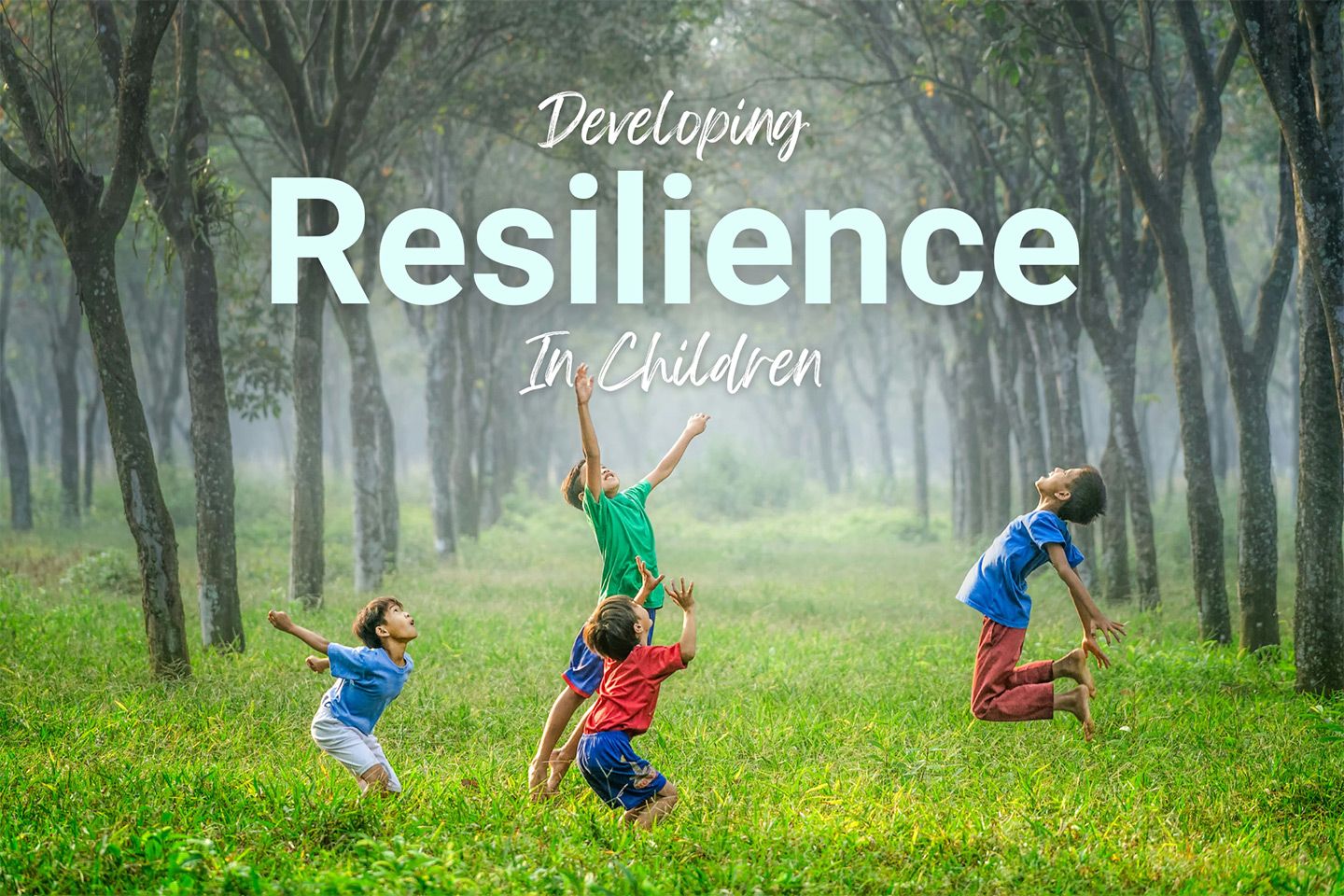
like when they don’t make it to the basketball team or struggle with an important exam, like the Primary School Leaving Examinations (PSLE). It’s tough, but these moments give them a chance to learn how to deal with adversities, which will help them bounce back even stronger than before. As parents, caregivers or teachers, we have that unique opportunity to help our children build resilience.
Resilience is the ability to bounce back from setbacks, learn from failures, and adapt to challenges. It’s a critical skill that helps children approach this unpredictable world with curiosity, adaptability, and perseverance.
Resilience isn’t just about overcoming tough times but about growing from them. Children who develop resilience tend to have better mental health, form stronger relationships, and do better in school and with friends. However, building resilience doesn’t happen overnight; it’s a journey, and every child’s path is unique. We can help our children nurture resilience to handle life’s challenges by providing patience, guidance, and the right strategies.
Children learn from watching what adults do, especially when dealing with difficult situations. That’s why parents and caregivers play a crucial role in helping children get through tough times. If you stay calm and focused when things get tough, your child will likely do the same.
It’s also helpful to show your child that you understand what they are going through and how they feel; create a space where they can talk openly about their feelings and let them know everything will be okay. How you act and what you say can make a big difference in how your child handles their emotions.
If you are still trying to figure out how to help your children build resilience, don’t worry. Here are some practical tips we compiled to get you started:
By fostering a sense of responsibility, you help your child develop life skills. They will learn to manage their time, prioritise tasks, and work towards their goals. Furthermore, feeling responsible can boost your child’s self-esteem and confidence.
By teaching your child about impermanence and how all things will change, they will understand that there is no need to control every aspect of their life. There will be changes that they have to grow and adapt to, becoming flexible in facing challenges and changes in their life.
By practising this together, you’re not just teaching them a valuable skill; you’re also helping them build resilience for life’s ups and downs!
Resilience is one of the most valuable life skills we can teach our children. It helps them handle life’s challenges with confidence and courage and become emotionally strong. As parents and caregivers, we need to create a supportive environment that encourages growth, emotional control, and learning from failure.
Building resilience takes time, patience, and understanding each child’s unique needs. What works for one child may not work for another, so be flexible. Look for opportunities in everyday life, like school challenges or helping around the house, to teach resilience.
Try out one of the strategies with your child today. It could be simply chatting about a recent challenge they faced or encouraging them to tackle a small problem by themselves. When you help your children build resilience, you prepare them for today’s challenges and equip them with the strength and mindset they’ll need for the rest of their lives.
If you want to understand resilience and how to support your children through tough times, you may wish to enroll your child in our Dharma Junior programme next year! Click here to find out more about Dharma Junio


Sacred Mirror
The Sacred Mirror represents consciousness and the element of space. Clear, pure and bright, the mirror reflects all phenomena objectively without bias, thereby reminding us to practice objectivity and to rise above our judgmental minds. On a more subtle level, it reflects the Buddha’s core teaching of emptiness – that nothing exists on its own side without a dependent arising cause.
Pinnacle of the mirror
The pinnacle of the mirror, formed by the white crescent moon, flaming red sun and an orange flame of fire, represents the completion stage of Vajrayana practice.
Light Rays
The light rays radiating from the Sacred Mirror represent the flourishing of the Buddha’s teachings, fanning out to the furthest reaches of the universe.
Full Moon Disc
The moon disc represents Bodhicitta, the aspiration to become a Buddha to benefit all sentient beings.
Blue Lotus
Divinely fragrant, blue lotuses bloomed only in the Buddha’s time. By incorporating it into the temple’s logo, it is symbolic of the ever-present Buddha in Thekchen Choling. Moreover, a lotus flower represents purity, perfection, compassion and renunciation, similar to how the beautiful lotus remains untainted even though it had arisen out from the muddy waters.
Nine Precious Jewels
These nine precious jewels represent the Guru, Buddha, Dharma, Sangha, yidam or mind-seal deity, Dharma protector, the sky, earth, and the human realm.
Two Dragons
The two dragons represent continuity and harmony and create the cause for the temple to enjoy the strong support of members and benefactors for Dharma to flourish.
Golden Khata
The flowing golden khata represents the auspicious increase of all Dharma activities.
The Seven Gems of the Chakravartin or a Wheel-Turning King
1. The precious horse represented by a unicorn’s horn
2. The precious elephant represented by its tusks
3. The precious queen represented by round golden earrings
4. The precious minister represented by square golden earrings
5. The precious general represented by a pair of crossed swords
6. The precious jewel represented by the triple-eyed gem
7. The precious Dharma wheel represented by a branch of coral