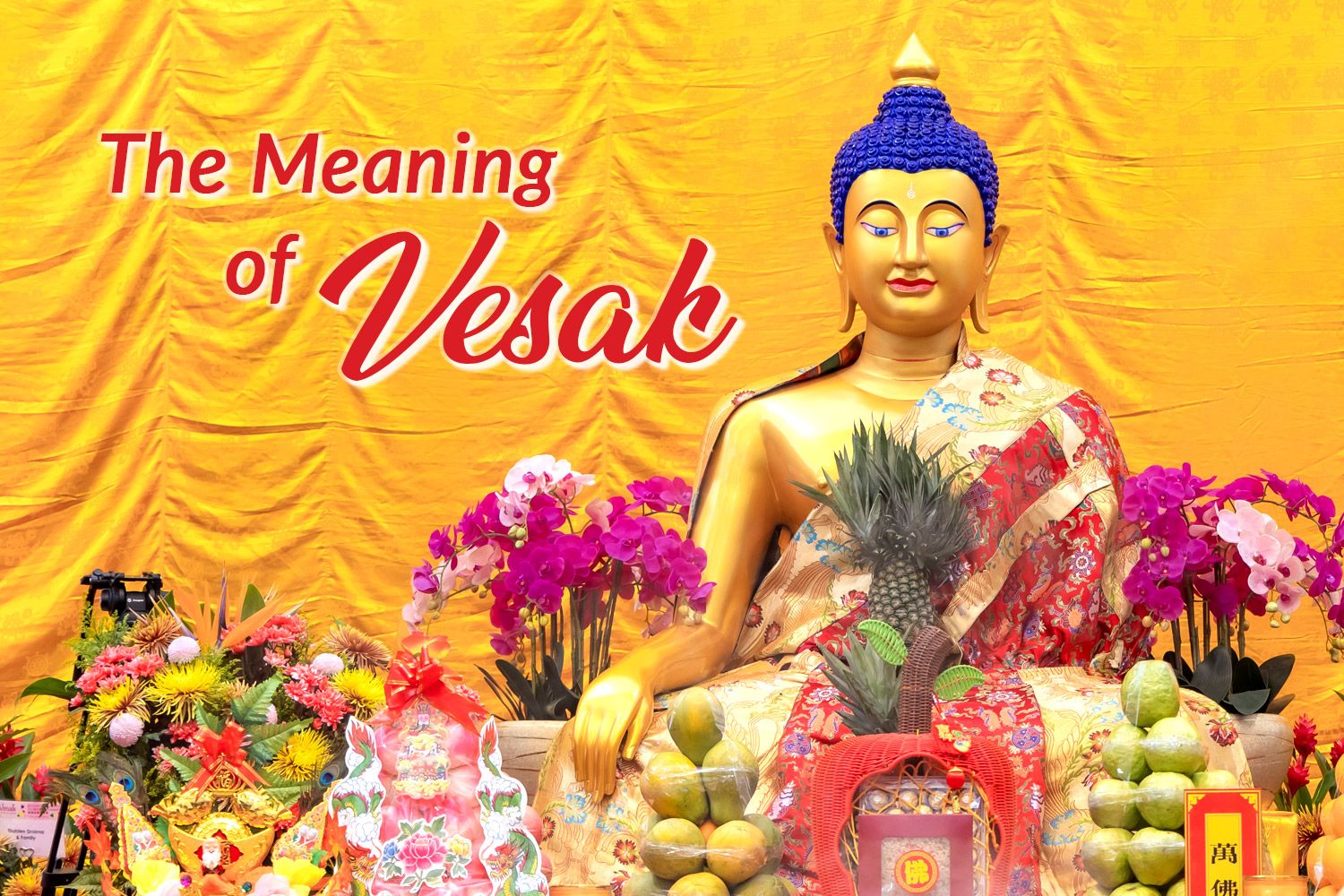
Every year, as Vesak approaches, we prepare our hearts and space to reflect on the life of Buddha, whose teachings continue to guide us 2,500 years later.
Vesak is more than a Buddhist holiday. It is a time to pause, remember, and reconnect with Buddha’s teachings and the guidance he provided for us.
What is Vesak?
Vesak—also known as Buddha Day—is the most sacred day for Buddhists worldwide and here in Singapore. It commemorates the three most important events in the life of Siddhartha Gautama, who later became enlightened as Shakyamuni Buddha:
• His birth in Lumbini,
• His enlightenment in Bodhgaya,
• And his passing (Parinirvana) in Kushinagar.
Instead of holding separate events, the Buddhist community celebrates all three milestones on this meaningful day as a time to reflect deeply—not only on the Buddha’s life but also on how we’re living ours.
Who Was Buddha, Really? His Journey
Did you know the Buddha was once a prince? More than 2,500 years ago, Siddhartha Gautama was born into a royal family and married by age 15. His name means “the one who achieves his goals.” His parents hoped he would become a great king, but as fate would have it, he became a great spiritual leader instead.
For the first 29 years, Siddhartha lived in luxury, sheltered from all forms of suffering. But one day, he left the palace and encountered what we now call the Four Sights: an old man, a sick man, a corpse, and a monk.
These encounters stirred him to ask: Why do we suffer? Is there a way to end it?
Driven by these questions, he left everything behind to seek the truth. After years of meditation and reflection, he reached enlightenment under the Bodhi tree and became known as the Buddha—the Awakened One.
He then spent the next 45 years walking across Northeast India, teaching the Dharma—the path to end suffering. His message was simple yet profound: every being has the potential to awaken.
Even at the end of his life, the Buddha reminded us to walk the path with mindfulness, compassion, and wisdom, and to rely on the Dharma as our guiding light.
The Three Traditions of Buddhism
As Buddhism spread across different regions, it naturally evolved into three main traditions. While they may look different on the outside, they all share the same heart: the teachings of the Buddha, aimed at awakening and compassion.
1. Theravāda Buddhism
Theravāda is the oldest tradition, practised mainly in Thailand, Sri Lanka, Cambodia, Laos and Myanmar. It’s often seen as the most closely aligned with the original teachings of the Buddha.
This tradition focuses on the core teachings, such as the Four Noble Truths, the Eightfold Path, and the Three Jewels (Buddha, Dharma, Sangha). It teaches concepts like impermanence, karma, and dependent origination and emphasises meditation practices such as samatha (calm) and vipassana (insight).
Theravāda emphasises monastic living and individual discipline, with monks striving to achieve arhat status––liberation from suffering.
In Singapore, Theravada Buddhism has a strong following as there is a history of temples founded by Thai, Sri Lankan and Burmese Venerables in the past. They continue to serve as an important place of learning till today.
2. Mahāyāna Buddhism
Mahāyāna, or the “Great Vehicle,” is the tradition most familiar to many Buddhists in Singapore.
It emphasises universal compassion and the aspiration to awaken not just for ourselves but for all beings. The spiritual role model in Mahāyāna is the bodhisattva—an individual who seeks enlightenment not just for themselves but is also motivated to help others awaken too.
While it shares many teachings with Theravāda, Mahāyāna uses additional scriptures and highlights that everyone, not just monks and nuns, has Buddhanature and can achieve awakening. Enlightenment can happen within this very lifetime, even amid everyday life.
The influx of Chinese immigrants since colonial times brought about most of the Buddhist temples and establishments that belong to the Chinese Mahayana tradition.
3. Vajrayāna Buddhism
Vajrayāna, or the “Diamond Vehicle,” is also commonly known as Tibetan Buddhism. It builds on Mahāyāna teachings and introduces rituals, visualisations, mantras, and meditation practices. Some practitioners view it as the fastest path to enlightenment, but it requires deep devotion and guidance from an experienced teacher.
Vajrayāna practices require guru devotion and seeing everything as a form of Dharma practice. Even our daily actions can be transformed into Dharma practice.
This tradition also embraces the dynamic energies of life, transforming even difficult emotions into tools for awakening. Its spiritual leadership includes respected lamas and gurus; notably, the Dalai Lama is the spiritual leader for Vajrayana Buddhism in the world.
Thekchen Choling is a temple of the Vajrayana tradition, founded by Singha Rinpoche. We have weekly teachings and Dharma courses that suit learners of different interests, based on teachings of the Lamrim to profound Vajrayana topics.
How We Celebrate Vesak at Thekchen Choling
Vesak is a day to honour Buddha’s great compassion in sharing his wisdom and renew our commitment to following his path. On Vesak Day, devotees begin by visiting the temple, making light offerings, and offering prayers of gratitude.
But Vesak is more than a ceremony. It’s about action.
During this time, many devotees perform acts of kindness—donating to the needy, benefitting animals, or simply being more present for loved ones. These small ways honour the Buddha’s legacy and live out his teachings daily.
Last year, Thekchen Choling temple celebrated Vesak with the beloved Animal Blessing Night. It was a joyful gathering of humans and their furry companions, focused on compassion. Visitors engaged in merit-making activities with their pets and explored animal welfare booths from organisations like NParks AVS, ASD, and Metta Cats & Dogs Sanctuary.
Many devotees and visitors generously donated to our Animal Welfare Fund, helping improve the lives of animals. Events like these remind us that the Dharma extends to all sentient beings, not just humans, and we are deeply grateful for the heartwarming participation and support.
A Celebration of Universal Love
Every tradition emphasises on Buddha’s boundless love and compassion. In the spirit of Vesak, we will be connecting with many people and animals during our vibrant Vesak celebrations.
Our Vesak celebrations are for everyone – both Buddhists and non-Buddhists. Come and experience for yourself how Thekchen Choling, a Vajrayana Buddhist temple, celebrates Vesak!
May your Vesak be joyous, meaningful, and filled with light. We look forward to celebrating it with you at the open field opposite NEX mall this year, from 10 –12 May! Click here to find out more about the exciting programme.
Sacred Mirror
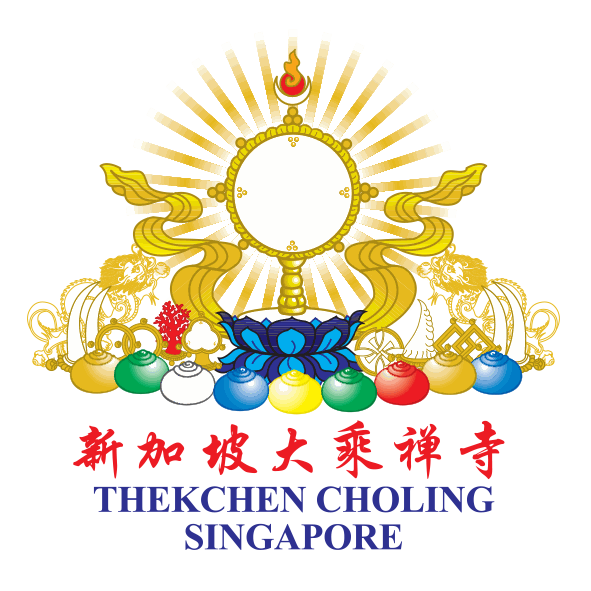
The Sacred Mirror represents consciousness and the element of space. Clear, pure and bright, the mirror reflects all phenomena objectively without bias, thereby reminding us to practice objectivity and to rise above our judgmental minds. On a more subtle level, it reflects the Buddha’s core teaching of emptiness – that nothing exists on its own side without a dependent arising cause.
Pinnacle of the mirror
The pinnacle of the mirror, formed by the white crescent moon, flaming red sun and an orange flame of fire, represents the completion stage of Vajrayana practice.
Light Rays
The light rays radiating from the Sacred Mirror represent the flourishing of the Buddha’s teachings, fanning out to the furthest reaches of the universe.
Full Moon Disc
The moon disc represents Bodhicitta, the aspiration to become a Buddha to benefit all sentient beings.
Blue Lotus
Divinely fragrant, blue lotuses bloomed only in the Buddha’s time. By incorporating it into the temple’s logo, it is symbolic of the ever-present Buddha in Thekchen Choling. Moreover, a lotus flower represents purity, perfection, compassion and renunciation, similar to how the beautiful lotus remains untainted even though it had arisen out from the muddy waters.
Nine Precious Jewels
These nine precious jewels represent the Guru, Buddha, Dharma, Sangha, yidam or mind-seal deity, Dharma protector, the sky, earth, and the human realm.
Two Dragons
The two dragons represent continuity and harmony and create the cause for the temple to enjoy the strong support of members and benefactors for Dharma to flourish.
Golden Khata
The flowing golden khata represents the auspicious increase of all Dharma activities.
The Seven Gems of the Chakravartin or a Wheel-Turning King
1. The precious horse represented by a unicorn’s horn
2. The precious elephant represented by its tusks
3. The precious queen represented by round golden earrings
4. The precious minister represented by square golden earrings
5. The precious general represented by a pair of crossed swords
6. The precious jewel represented by the triple-eyed gem
7. The precious Dharma wheel represented by a branch of coral