

“Many Buddhists are attracted to New Age spirituality because they would like to surrender everything to the universe and let the universe decide. But in Buddhism, we are training to make conscious decisions for our own lives.”
Dignity is something that is beyond the body. Dignity comes from divinity. To be dignified, we have to be able to release the idea of selfishness.
In cultivating dharma, we must be willing to loosen the grip on our identity. According to Lama Zopa, after practicing the dharma, when we start to feel insecure, that is a sign that the dharma is finally working for us. When we begin to feel unsure of ourselves and afraid, dharma starts to set in, making us realize that everything is impermanent.
New Age spirituality focuses on indulging oneself with oneself and “going with the flow.” However, one’s focus must always stay on self-awareness. Our spiritual practice aims to show us who we really are and evolve from that state.
When things don’t turn out the way we had hoped or expected them to, we must not lose hope. What will bear fruit, make our lives better, and make all of the dharma studies take effect, will be our ability to see the good in all beings with the right motivation to help others.
Many people study the dharma with no merit. So they intellectualize the dharma and yet remain unhappy. The other extreme is when someone has great faith, belief, and devotion, but there is no study, so there is not much understanding of the dharma. In either case, without merit, it is so difficult for results to accrue. Merit accumulation is essential.
Making offerings to the sangha and the Triple Gem is the route to merit. Please do it. Pray, make offerings, and see for yourself. The personality of a person who does these things consistently starts to shift. Watch out for wrong views because things can quickly turn, and we can crash because wrong views can destroy our merit.
If we think we can study the dharma and base it only on the law of cause and effect, we are mistaken.
If we question the point of purification, accumulating merit, reciting the names of the Buddhas, or dedicating, we are indeed missing the flow.
To flow with dignity – with divinity – it is vital to cultivate and to grow merit and pure perception, which is the foundation of tantra. By doing so, there is hope for enlightenment.
Many people can quickly develop a wrong view when they don’t get what they want. So let us practice with divine clarity and, in doing so, achieve an inner dignity as a human being and as a bodhisattva.
Dharma Teaching by Singha Rinpoche and edited by Sandeep Nath
20 Dec 2020
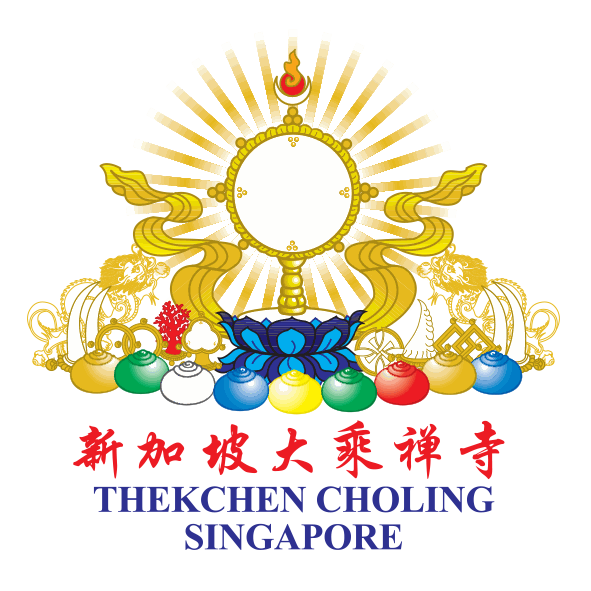
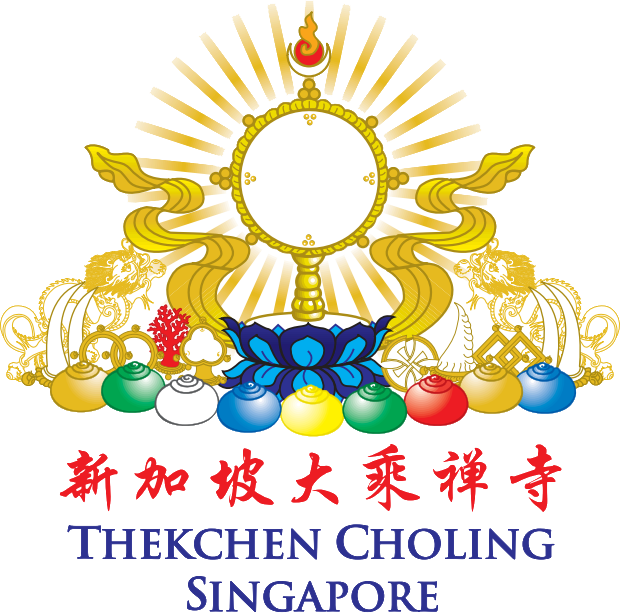
Sacred Mirror
The Sacred Mirror represents consciousness and the element of space. Clear, pure and bright, the mirror reflects all phenomena objectively without bias, thereby reminding us to practice objectivity and to rise above our judgmental minds. On a more subtle level, it reflects the Buddha’s core teaching of emptiness – that nothing exists on its own side without a dependent arising cause.
Pinnacle of the mirror
The pinnacle of the mirror, formed by the white crescent moon, flaming red sun and an orange flame of fire, represents the completion stage of Vajrayana practice.
Light Rays
The light rays radiating from the Sacred Mirror represent the flourishing of the Buddha’s teachings, fanning out to the furthest reaches of the universe.
Full Moon Disc
The moon disc represents Bodhicitta, the aspiration to become a Buddha to benefit all sentient beings.
Blue Lotus
Divinely fragrant, blue lotuses bloomed only in the Buddha’s time. By incorporating it into the temple’s logo, it is symbolic of the ever-present Buddha in Thekchen Choling. Moreover, a lotus flower represents purity, perfection, compassion and renunciation, similar to how the beautiful lotus remains untainted even though it had arisen out from the muddy waters.
Nine Precious Jewels
These nine precious jewels represent the Guru, Buddha, Dharma, Sangha, yidam or mind-seal deity, Dharma protector, the sky, earth, and the human realm.
Two Dragons
The two dragons represent continuity and harmony and create the cause for the temple to enjoy the strong support of members and benefactors for Dharma to flourish.
Golden Khata
The flowing golden khata represents the auspicious increase of all Dharma activities.
The Seven Gems of the Chakravartin or a Wheel-Turning King
1. The precious horse represented by a unicorn’s horn
2. The precious elephant represented by its tusks
3. The precious queen represented by round golden earrings
4. The precious minister represented by square golden earrings
5. The precious general represented by a pair of crossed swords
6. The precious jewel represented by the triple-eyed gem
7. The precious Dharma wheel represented by a branch of coral