“Hell does not necessarily mean taking rebirth in Hell. It means that our life can be Hell right now, with depression, worry, and overthinking,”
Here is the bottom line: Pure view can save us from ending up in Hell, regardless of whether we accept that there is a next life or not. Pure view is the antidote to the cause of being reborn in the lowest of the low hells known in Buddhism as the “Avicci” hells. Wrong view is the root of disharmony within a sangha. This disharmony is one of the five uninterrupted negative karmas that yields immediate suffering from the moment it arises.
In this samsaric world, all beings entitle themselves to all the thoughts and manners of righteousness. Many think that righteousness is the way to go, but self-righteousness is not born out of compassion. It cannot be born out of genuine care and compassion because we judge due to it. We need to gain wisdom to differentiate a comment from the result of a comment. Many like to make comments but what matters is whether those comments leave the imprints for disharmony. Once the seed of discord sprouts, it is tough to put a stop to it. Just one small spark, and it can become like a great forest fire.
Pure view is a practice and is the result of the cultivation of rejoicing. We need to practice seeing the good in others and rejoice in it. As practitioners and cultivators, we must maintain our minds. If we let the weeds take root and begin to grow and take over, it is impossible to get rid of them. There will be harm. So we need to make an effort to maintain the mind, keep our cultivation, and maintain our practice, to root out the negative thoughts toward self and others. These negative thoughts are based only on our own beliefs and self-cherishing, the very root of our ideas, and our own identity.
The effort must be in keeping a pure view, a clear perception of all phenomena. We must not believe everything we think. We don’t have to learn any more to unlearn. We only need to meditate to open it all up, layer by layer. It is hard work, and it can be painful. It is all right to feel different – even negative – emotions while doing this, but there is no need to spread them around.
Meditation is the best way to put our minds at ease. It is a way for us to experience real inner serenity. Life is not just all about solving problems. As long as we are in samsara, samsara will always present us with many issues. Instead, let us experience cultivation through our meditation. In this way, the mind can gradually become more gentle and then soft enough to see the good in others. And surround ourselves with Heaven!
Dharma teaching by Singha Rinpoche and edited by Sandeep Nath
3 Jan 2021
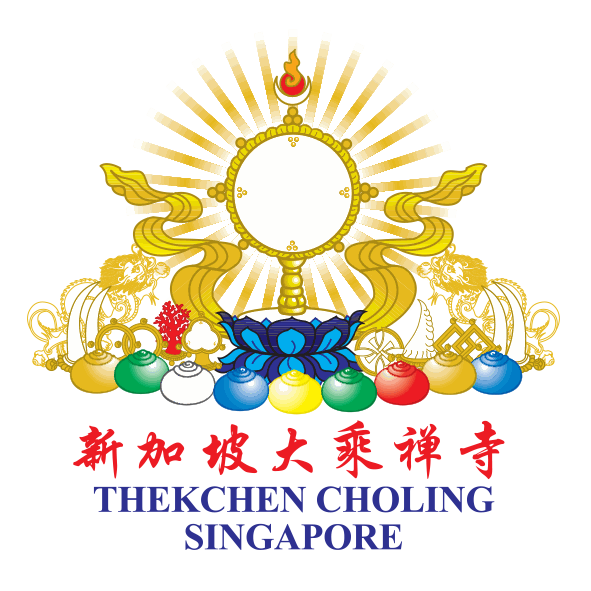
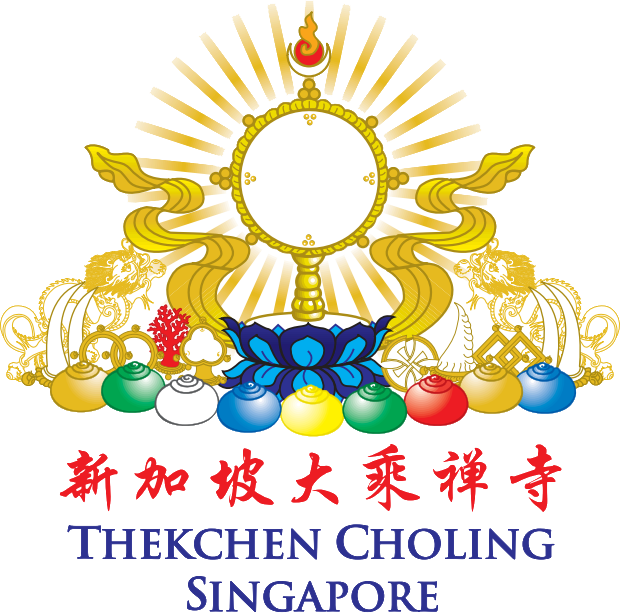
Sacred Mirror
The Sacred Mirror represents consciousness and the element of space. Clear, pure and bright, the mirror reflects all phenomena objectively without bias, thereby reminding us to practice objectivity and to rise above our judgmental minds. On a more subtle level, it reflects the Buddha’s core teaching of emptiness – that nothing exists on its own side without a dependent arising cause.
Pinnacle of the mirror
The pinnacle of the mirror, formed by the white crescent moon, flaming red sun and an orange flame of fire, represents the completion stage of Vajrayana practice.
Light Rays
The light rays radiating from the Sacred Mirror represent the flourishing of the Buddha’s teachings, fanning out to the furthest reaches of the universe.
Full Moon Disc
The moon disc represents Bodhicitta, the aspiration to become a Buddha to benefit all sentient beings.
Blue Lotus
Divinely fragrant, blue lotuses bloomed only in the Buddha’s time. By incorporating it into the temple’s logo, it is symbolic of the ever-present Buddha in Thekchen Choling. Moreover, a lotus flower represents purity, perfection, compassion and renunciation, similar to how the beautiful lotus remains untainted even though it had arisen out from the muddy waters.
Nine Precious Jewels
These nine precious jewels represent the Guru, Buddha, Dharma, Sangha, yidam or mind-seal deity, Dharma protector, the sky, earth, and the human realm.
Two Dragons
The two dragons represent continuity and harmony and create the cause for the temple to enjoy the strong support of members and benefactors for Dharma to flourish.
Golden Khata
The flowing golden khata represents the auspicious increase of all Dharma activities.
The Seven Gems of the Chakravartin or a Wheel-Turning King
1. The precious horse represented by a unicorn’s horn
2. The precious elephant represented by its tusks
3. The precious queen represented by round golden earrings
4. The precious minister represented by square golden earrings
5. The precious general represented by a pair of crossed swords
6. The precious jewel represented by the triple-eyed gem
7. The precious Dharma wheel represented by a branch of coral