“Healing your inner world means that you are supposed to grow. The point of healing is to learn something, to improve, and then to grow from it. Evolving is the only way to go forward.”
We always seem to have the time to complain about inconveniences, yet many do not have time to appreciate and have gratitude for life itself.
How do we heal this inner world in which we all are suffering? This question itself poses a great deal of reflection, but it is still an utterly self-centered question. Why don’t we instead think about how we can blend peacefully with nature? We have disassociated ourselves from nature, but in fact, we are nature. Every single part of us is organic and natural. We all fall sick, we all die, and we all decompose. Yet, we live as though there is no tomorrow in terms of our irresponsible consumerism. If we look at how we can make the world a better place by changing our lifestyles and habits, most of us are going in the wrong direction by encouraging more consumerism. This is the cycle of samsara, and we all are the creators of it.
Instead of recognizing it and thinking about what we may have done wrong, we tend to become offended and defensive. People often try to help us, and we knowingly or unknowingly disrespect them when we disregard their advice and then blame them when we don’t get the expected results. We become consumers of healing practices themselves.
Healing does, in fact, begin with a recognition of our oneness with nature. Nature is inside us, part of our inner world. And though it might look different as we heal and grow, nature is always who we are.
If we were to take a seed and soak it overnight, what would happen? The seed will reconstitute with water. The skin will split open, and it will sprout. Every seed that flourishes has to go through this process! The seed can not remain in its original form once the skin is broken open. That change is a sign that it has evolved, and it needs to grow. We all must do the same.
Due to our habits, we often fail to see this as an opportunity. We want things the way they were before. We want ourselves also to remain as we were. That is not healing. Growth is healing. Everything that arises in our life is a sign for each of us to be better than before. Our focus should be on how we can continue to evolve. So we must stop complaining, stop blaming, and stop justifying and learn to grow from it instead.
We are all the recipients of our karma. Healing our inner world should not be done by protecting our ego with more and more layers. Rather, forget about healing it and, instead, grow from it.
Dharma Teaching by Singha Rinpoche and edited by Sandeep Nath
10 Jan 2021
Sacred Mirror
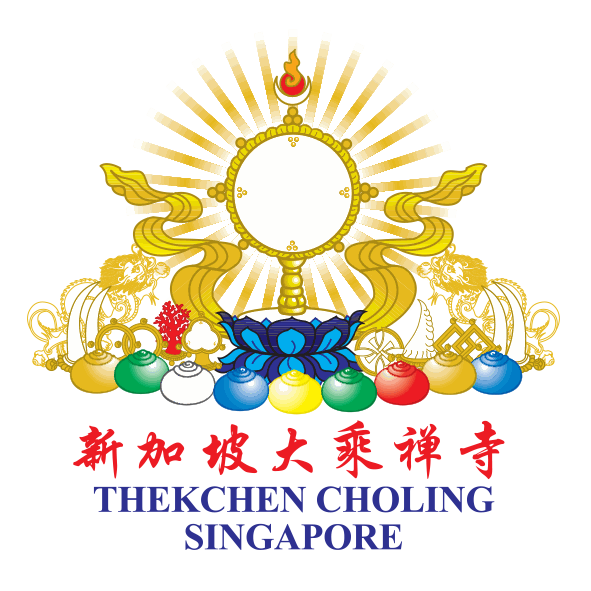
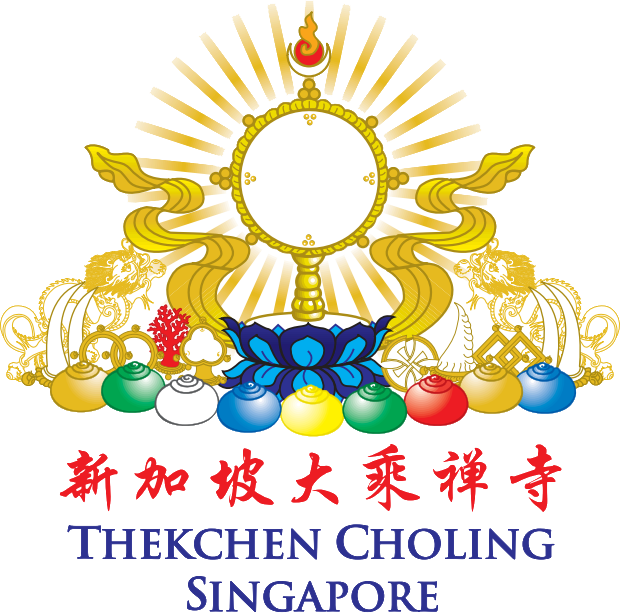
The Sacred Mirror represents consciousness and the element of space. Clear, pure and bright, the mirror reflects all phenomena objectively without bias, thereby reminding us to practice objectivity and to rise above our judgmental minds. On a more subtle level, it reflects the Buddha’s core teaching of emptiness – that nothing exists on its own side without a dependent arising cause.
Pinnacle of the mirror
The pinnacle of the mirror, formed by the white crescent moon, flaming red sun and an orange flame of fire, represents the completion stage of Vajrayana practice.
Light Rays
The light rays radiating from the Sacred Mirror represent the flourishing of the Buddha’s teachings, fanning out to the furthest reaches of the universe.
Full Moon Disc
The moon disc represents Bodhicitta, the aspiration to become a Buddha to benefit all sentient beings.
Blue Lotus
Divinely fragrant, blue lotuses bloomed only in the Buddha’s time. By incorporating it into the temple’s logo, it is symbolic of the ever-present Buddha in Thekchen Choling. Moreover, a lotus flower represents purity, perfection, compassion and renunciation, similar to how the beautiful lotus remains untainted even though it had arisen out from the muddy waters.
Nine Precious Jewels
These nine precious jewels represent the Guru, Buddha, Dharma, Sangha, yidam or mind-seal deity, Dharma protector, the sky, earth, and the human realm.
Two Dragons
The two dragons represent continuity and harmony and create the cause for the temple to enjoy the strong support of members and benefactors for Dharma to flourish.
Golden Khata
The flowing golden khata represents the auspicious increase of all Dharma activities.
The Seven Gems of the Chakravartin or a Wheel-Turning King
1. The precious horse represented by a unicorn’s horn
2. The precious elephant represented by its tusks
3. The precious queen represented by round golden earrings
4. The precious minister represented by square golden earrings
5. The precious general represented by a pair of crossed swords
6. The precious jewel represented by the triple-eyed gem
7. The precious Dharma wheel represented by a branch of coral