
It is 1999.
The digits on the clock reads 8.10pm.
The phone rings.
A familiar voice drifts out from the phone. “Why are you not attending teaching?” It is Singha Rinpoche.
He does not sound pleased. I make up some lame excuse and he brushes it off.
“Come now,” he says.
My spouse and I arrive and try to sneak in unnoticed. It is extremely difficult as there are less than a dozen students and the room is small. Lama (that’s what we called him then) – his face is unsmiling and clearly very annoyed. He says nothing and we all look uncomfortable. Unlike the usual times, he sits on the floor this time and not on the sofa (teaching throne).
At that time Lama had just begun to teach, so each student had agreed that we would make a monthly offering to him. We were in effect his “sponsors”. This did not influence him, because for about an hour that evening, we all received the most severe scolding any of us had experienced in some time (we were all older than him by at least 10 years).
However, what he said left a deep impression – he told us we were taking the Buddhadharma and our precious human life for granted. We were ignorant in not realizing we could die at any time so we behaved like we could live forever, not cherishing the fact that we were receiving something even more valuable than all the precious metals on Earth. We were receiving dharma teachings.
I asked Rinpoche recently why at that time, in 1999, he had never seemed concerned about the fact that the students he was reprimanding might leave or stop making offerings. He said the thought never crossed his mind. It was important for him that he not give up on us and he had to be brave and care – and get through to us. And if scolding was the means, he would do that.
Regrettably, the partings did happen. Over the years students and disciples left, mistaking the scolding to be really that and not realizing the care and love behind it. If ever, you feel you are being “scolded” by Rinpoche, please try your best to view that as a blessing, a gesture of caring, a medicine that will benefit – perhaps bitter but beneficial.
Tenzin
26 Sep 2021
Sacred Mirror
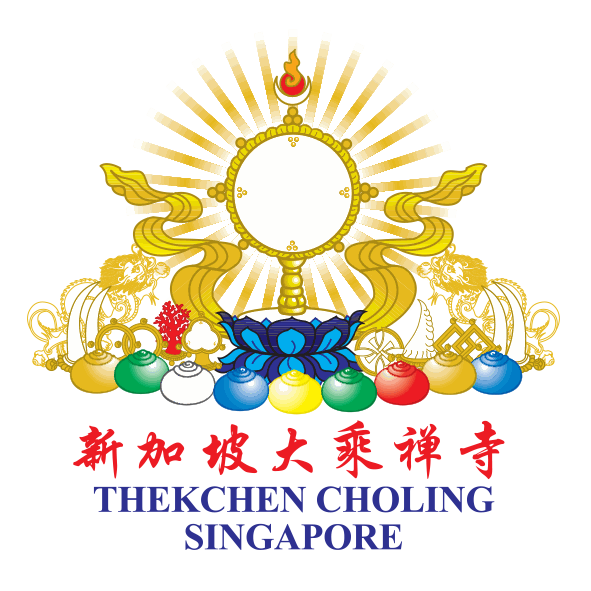
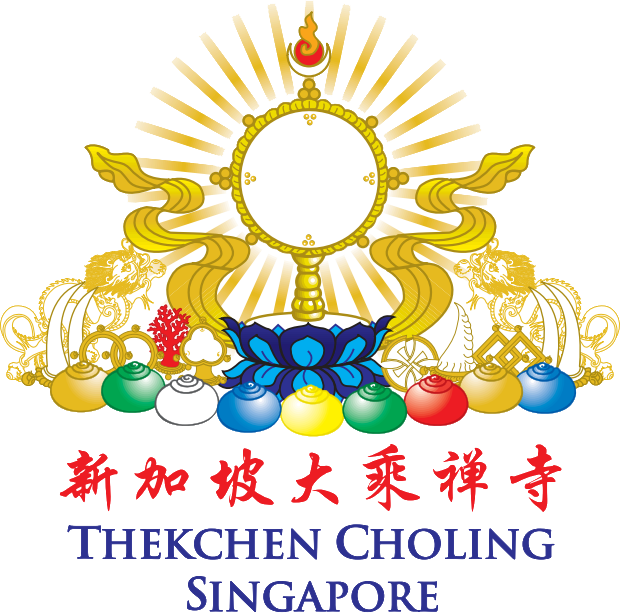
The Sacred Mirror represents consciousness and the element of space. Clear, pure and bright, the mirror reflects all phenomena objectively without bias, thereby reminding us to practice objectivity and to rise above our judgmental minds. On a more subtle level, it reflects the Buddha’s core teaching of emptiness – that nothing exists on its own side without a dependent arising cause.
Pinnacle of the mirror
The pinnacle of the mirror, formed by the white crescent moon, flaming red sun and an orange flame of fire, represents the completion stage of Vajrayana practice.
Light Rays
The light rays radiating from the Sacred Mirror represent the flourishing of the Buddha’s teachings, fanning out to the furthest reaches of the universe.
Full Moon Disc
The moon disc represents Bodhicitta, the aspiration to become a Buddha to benefit all sentient beings.
Blue Lotus
Divinely fragrant, blue lotuses bloomed only in the Buddha’s time. By incorporating it into the temple’s logo, it is symbolic of the ever-present Buddha in Thekchen Choling. Moreover, a lotus flower represents purity, perfection, compassion and renunciation, similar to how the beautiful lotus remains untainted even though it had arisen out from the muddy waters.
Nine Precious Jewels
These nine precious jewels represent the Guru, Buddha, Dharma, Sangha, yidam or mind-seal deity, Dharma protector, the sky, earth, and the human realm.
Two Dragons
The two dragons represent continuity and harmony and create the cause for the temple to enjoy the strong support of members and benefactors for Dharma to flourish.
Golden Khata
The flowing golden khata represents the auspicious increase of all Dharma activities.
The Seven Gems of the Chakravartin or a Wheel-Turning King
1. The precious horse represented by a unicorn’s horn
2. The precious elephant represented by its tusks
3. The precious queen represented by round golden earrings
4. The precious minister represented by square golden earrings
5. The precious general represented by a pair of crossed swords
6. The precious jewel represented by the triple-eyed gem
7. The precious Dharma wheel represented by a branch of coral