
This is the first of a series of stories that are reflections of experiences with my root Guru, Singha Rinpoche. To enable a certain honesty, these are written with the pen name, Tenzin. Some stories are my own experiences and some of other students.
The traditional method of applying the Buddha’s teachings to our lives can be likened to daily medicinal tonic, a slow, gradual process through listening, contemplating and meditating. But Rinpoche’s methods are sometimes more like injections, or even surgery. Fast acting but possibly “dangerous”, both for him and the student.
I now consider myself very fortunate to have experienced everything – from receiving a severe scolding from him to being present during difficult and frustrating situations. These have been life changing. These stories are recounted mostly to remind myself of my Guru’s kindness and his unceasing motivation to benefit others regardless of his actions. (So if I ever see faults in him, may these serve as a reminder and as an antidote to my monkey mind, and hopefully yours too).
Singha Rinpoche – Lama Felix as he was known then – emerged from his restaurant kitchen where he was proprietor, in a singlet, sweaty from cooking and said, “I am going to start teaching Buddhism ”.
I replied, “Can I come and what do I have to bring?”.
“Bring your body, speech and mind”.
He did not look like the typical Buddhist teacher, but appearances can be deceiving. To be approachable, this was his appearance. We only realised that perhaps he was someone “important”, when we went to Kopan Monastery in Nepal with him years later and monks prostrated to him as he walked around the monastery. He could have lived a more predictable and simpler life as a Lama at a monastery but his teachers had told him to remain a lay person to benefit more people.
Although his café was very popular (the food was VERY good), Rinpoche was instructed by his Gurus to shut his restaurant down and start teaching. How many of us would even consider doing that? Give up our livelihood for which we have trained and start doing something with no salary just because our Guru said so? This was an introduction to how seriously he takes his Gurus’ instructions – not be a monastic but also not have a worldly occupation. When he taught the Lam-Rim teachings about the importance of following the instructions of the Guru, we could be certain that the teaching was authentic – he is a living example after all.
At the end of the first teaching I attended, others were giving him a white scarf to say thank you. I felt I should say thank you. But I was also very conflicted, for Buddhism was not the religion of my birth and changing religions is not trivial.
I went up to Rinpoche and he said, “you are Buddhist inside”. My worries melted and I felt a load lifted. I have experienced and heard him on many occasions say just the right thing at the right time – some of you have experienced that too, as illustrated in the book “My Guru’s Words”.
All these experiences have taught me that his words are not to be taken lightly. Many of us are fortunate to spend quite a bit of time with him (unlike other “high Lamas” who we might meet for a few minutes a year at best) but this also means we run the risk of underestimating the importance of his instructions and advice. I have certainly made that mistake very often and now try not to take these for granted.
Tenzin
29 Aug 2021
Sacred Mirror
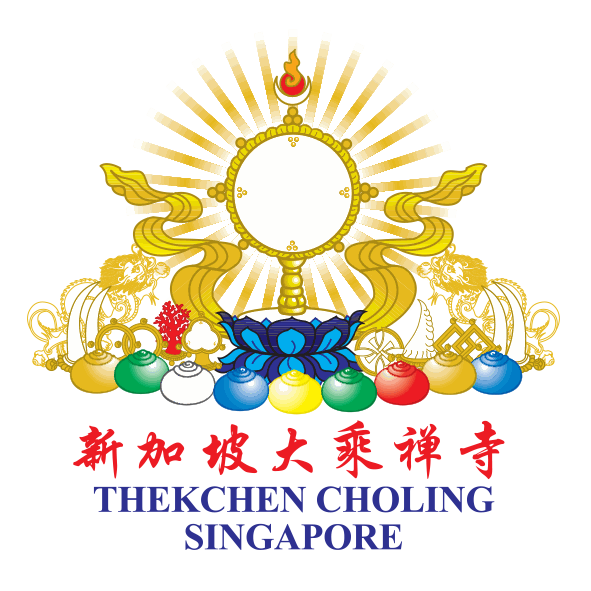
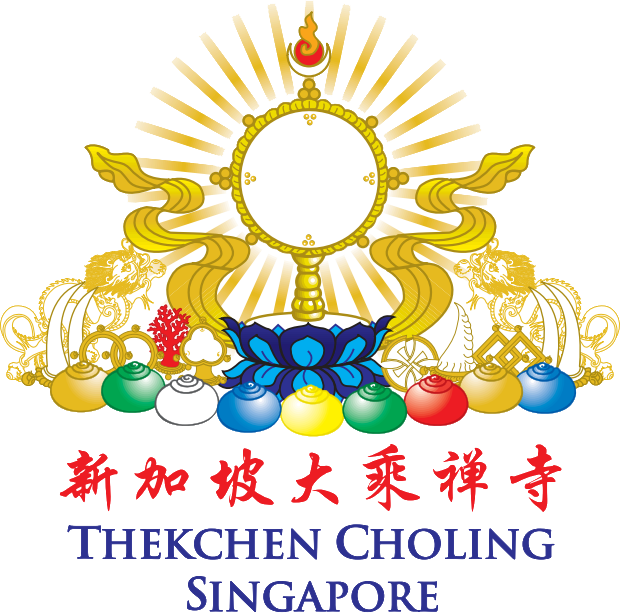
The Sacred Mirror represents consciousness and the element of space. Clear, pure and bright, the mirror reflects all phenomena objectively without bias, thereby reminding us to practice objectivity and to rise above our judgmental minds. On a more subtle level, it reflects the Buddha’s core teaching of emptiness – that nothing exists on its own side without a dependent arising cause.
Pinnacle of the mirror
The pinnacle of the mirror, formed by the white crescent moon, flaming red sun and an orange flame of fire, represents the completion stage of Vajrayana practice.
Light Rays
The light rays radiating from the Sacred Mirror represent the flourishing of the Buddha’s teachings, fanning out to the furthest reaches of the universe.
Full Moon Disc
The moon disc represents Bodhicitta, the aspiration to become a Buddha to benefit all sentient beings.
Blue Lotus
Divinely fragrant, blue lotuses bloomed only in the Buddha’s time. By incorporating it into the temple’s logo, it is symbolic of the ever-present Buddha in Thekchen Choling. Moreover, a lotus flower represents purity, perfection, compassion and renunciation, similar to how the beautiful lotus remains untainted even though it had arisen out from the muddy waters.
Nine Precious Jewels
These nine precious jewels represent the Guru, Buddha, Dharma, Sangha, yidam or mind-seal deity, Dharma protector, the sky, earth, and the human realm.
Two Dragons
The two dragons represent continuity and harmony and create the cause for the temple to enjoy the strong support of members and benefactors for Dharma to flourish.
Golden Khata
The flowing golden khata represents the auspicious increase of all Dharma activities.
The Seven Gems of the Chakravartin or a Wheel-Turning King
1. The precious horse represented by a unicorn’s horn
2. The precious elephant represented by its tusks
3. The precious queen represented by round golden earrings
4. The precious minister represented by square golden earrings
5. The precious general represented by a pair of crossed swords
6. The precious jewel represented by the triple-eyed gem
7. The precious Dharma wheel represented by a branch of coral