

The lady was crying.
Rinpoche had just spoken to her and the three of us stood there, somewhat awkward.
Rinpoche said, “You three better talk to her”.
We looked at each other, a bit lost. We invited her into a room, turned on the air conditioning and sat as she recounted her story. “That man (Rinpoche) was so rude. I came to ask for advice because my friend asked me to come and he told me the way I talk is the main problem – that I am rude.”
We tried to placate her, asked some questions about her as an icebreaker and tried to keep the conversation going. As we were talking, I recall at one point she said, “You see, the three of you are so nice and kind, not like that man “.
As we were talking, she suddenly raised her voice and snapped at us. “Can you please turn down the aircon? It’s so cold you know”. Silence. One of us turned the aircon temperature up. We looked at one another knowingly and realised Rinpoche was right. Her problem was her way of speaking; she could suddenly come across as rude.
As the conversation progressed, we noticed that there were several times when she was aggressive and quite rude. BUT – none of us dared or cared enough to tell her directly that Rinpoche was right. We sort of hinted at it and we tried to tell her “nicely”. (I mean we were supposed to be nice – right?)
As I think back to that day, I wondered about what it means to be “nice”. How many people in our lives will tell us things we really do need to hear so we can change? For these things may be the root of our problems.
So when Rinpoche says to you that you are slow, egotistical, too money minded – is that being rude and “not nice”? Well, it hurts for sure, but when it’s valid – if we ask others around us and if most agree that we are just what Rinpoche has pointed out, but they have never said it to your face – then the question is, who is really being nice ?
Tenzin
24 Oct 2021
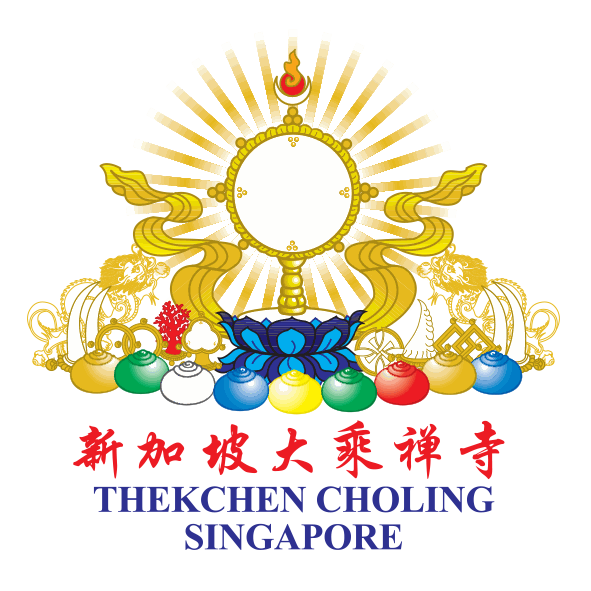
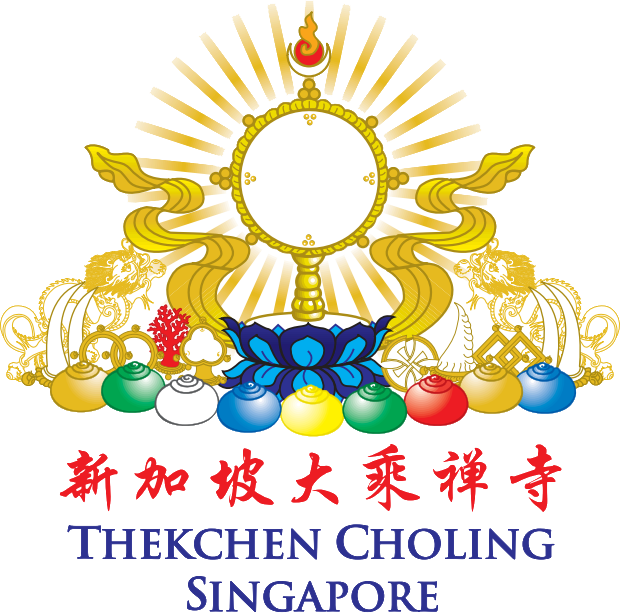
Sacred Mirror
The Sacred Mirror represents consciousness and the element of space. Clear, pure and bright, the mirror reflects all phenomena objectively without bias, thereby reminding us to practice objectivity and to rise above our judgmental minds. On a more subtle level, it reflects the Buddha’s core teaching of emptiness – that nothing exists on its own side without a dependent arising cause.
Pinnacle of the mirror
The pinnacle of the mirror, formed by the white crescent moon, flaming red sun and an orange flame of fire, represents the completion stage of Vajrayana practice.
Light Rays
The light rays radiating from the Sacred Mirror represent the flourishing of the Buddha’s teachings, fanning out to the furthest reaches of the universe.
Full Moon Disc
The moon disc represents Bodhicitta, the aspiration to become a Buddha to benefit all sentient beings.
Blue Lotus
Divinely fragrant, blue lotuses bloomed only in the Buddha’s time. By incorporating it into the temple’s logo, it is symbolic of the ever-present Buddha in Thekchen Choling. Moreover, a lotus flower represents purity, perfection, compassion and renunciation, similar to how the beautiful lotus remains untainted even though it had arisen out from the muddy waters.
Nine Precious Jewels
These nine precious jewels represent the Guru, Buddha, Dharma, Sangha, yidam or mind-seal deity, Dharma protector, the sky, earth, and the human realm.
Two Dragons
The two dragons represent continuity and harmony and create the cause for the temple to enjoy the strong support of members and benefactors for Dharma to flourish.
Golden Khata
The flowing golden khata represents the auspicious increase of all Dharma activities.
The Seven Gems of the Chakravartin or a Wheel-Turning King
1. The precious horse represented by a unicorn’s horn
2. The precious elephant represented by its tusks
3. The precious queen represented by round golden earrings
4. The precious minister represented by square golden earrings
5. The precious general represented by a pair of crossed swords
6. The precious jewel represented by the triple-eyed gem
7. The precious Dharma wheel represented by a branch of coral