
There is a contradiction in all of us – we always seek a peaceful, stable, serene life with no problems. Yet, for probably all of us, when we look back at our lives, we realise that we grew, learnt and changed most as a result of (very often) challenging, difficult or stressful situations.
In some Buddhist texts, it mentions that a Guru has to “pull the rug from under your feet” so we “progress” on the path. For some older students, from our experiences with Singha Rinpoche, it is something that he does quite well.
Year 2000. Mid or late I can’t quite remember. Anyway, exact dates are not important. The group of students had grown a little and what was to become Thekchen Choling operated out of a private property in the Thong Soon area. Complaints by residents about parking and noise meant the presence of the authorities – specifically URA. They came and told us we had to vacate.
A few months later, we found an alternate location at Hindhede Road. By that time, the move was quite significant, with a full altar, statues, furniture etc. Some of which went to Hindhede and some moved elsewhere due to the lack of space. There was no committee or staff. We had not set up a society so we all just assumed that someone would always be there to help. But there was no organised, clear, defined moving plan. We were all mostly in our 30’s or early 40’s and busy with work and young families.
The move was quite chaotic. I would get a call suddenly asking me to come down and help move some furniture and/or pack or unpack. As students, all of us received these calls, sometimes from Rinpoche and sometimes from other students asking for help. “Please come lah, I am alone and Lama wants to move the big cupboard now”. We all were often pretty annoyed at how disorganized it was. Looking back now while writing this, I realise how silly this all sounds. At that time though, I often got irritated as did some others (and tired – remember it was not very many students).
BUT, all of this chaos brought us together. We realised we had to help one another. Each of us experienced being the one trying to call others for help or being called. We were all from very different backgrounds and had only recently come to know each other. This and similar situations dissolved our selfishness a bit. We looked beyond our differences – who was rich or poor, the languages we spoke. A culture was created where we trusted and would help each other. These bonds made a huge difference when we had to work together to set up Thekchen Choling. Like a bunch of chopsticks put together, providing strength when together and not as individuals, as Rinpoche would constantly remind us then.
After some time, when we were reminiscing about this period, we all felt that Rinpoche may have done this – being skilfully disorganized and creating difficult situations for us – on purpose.
Over the next 20 years, we learnt that, from time to time, to wake us up from laziness and complacency, Rinpoche would do this in different ways.
At some point, he sort of admitted when we asked. But very often when we did ask, his reply would typically be “I never do anything” . Which from a wisdom perspective, seems to be the perfect reply.
Tenzin
10 Oct 2021
Sacred Mirror
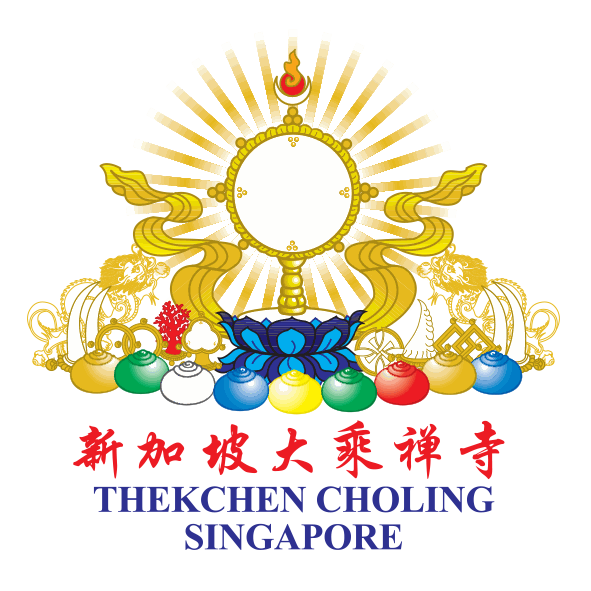
The Sacred Mirror represents consciousness and the element of space. Clear, pure and bright, the mirror reflects all phenomena objectively without bias, thereby reminding us to practice objectivity and to rise above our judgmental minds. On a more subtle level, it reflects the Buddha’s core teaching of emptiness – that nothing exists on its own side without a dependent arising cause.
Pinnacle of the mirror
The pinnacle of the mirror, formed by the white crescent moon, flaming red sun and an orange flame of fire, represents the completion stage of Vajrayana practice.
Light Rays
The light rays radiating from the Sacred Mirror represent the flourishing of the Buddha’s teachings, fanning out to the furthest reaches of the universe.
Full Moon Disc
The moon disc represents Bodhicitta, the aspiration to become a Buddha to benefit all sentient beings.
Blue Lotus
Divinely fragrant, blue lotuses bloomed only in the Buddha’s time. By incorporating it into the temple’s logo, it is symbolic of the ever-present Buddha in Thekchen Choling. Moreover, a lotus flower represents purity, perfection, compassion and renunciation, similar to how the beautiful lotus remains untainted even though it had arisen out from the muddy waters.
Nine Precious Jewels
These nine precious jewels represent the Guru, Buddha, Dharma, Sangha, yidam or mind-seal deity, Dharma protector, the sky, earth, and the human realm.
Two Dragons
The two dragons represent continuity and harmony and create the cause for the temple to enjoy the strong support of members and benefactors for Dharma to flourish.
Golden Khata
The flowing golden khata represents the auspicious increase of all Dharma activities.
The Seven Gems of the Chakravartin or a Wheel-Turning King
1. The precious horse represented by a unicorn’s horn
2. The precious elephant represented by its tusks
3. The precious queen represented by round golden earrings
4. The precious minister represented by square golden earrings
5. The precious general represented by a pair of crossed swords
6. The precious jewel represented by the triple-eyed gem
7. The precious Dharma wheel represented by a branch of coral