It was early 1999. Singha Rinpoche had advised a student that he should have 100,000 Tsa-Tsa – the small statue you can wear in an amulet or sometimes bigger – of Lama Tsongkhapa made. Rinpoche also wanted to go to visit the stupa of his Buddhist teacher Phra Mahathongkum outside of Bangkok. So off we went, a handful of students and Rinpoche to Bangkok for a sort of “pilgrimage”.
We took a tour, visited some temples in Bangkok, and did the usual touristy things. In my mind, I thought the main purpose of the trip was to ensure that the Tsa-Tsa was made and the visit to the stupa. Anything touristy just seemed so worldly and not in line with MY idea of a pilgrimage. You can then understand how frustrated I was. There they were, my fellow pilgrims and Rinpoche, inside a jewellery shop in a shopping mall, spending what seemed like forever looking at jade and various precious and semi-precious stones. I decided to wait outside the shop, noticeably bored and wondering, “what am I doing here?”
Rinpoche came out of the shop and said to me, “Do you know what I am thinking about?” I shook my head. He said, “I am visualising a Buddha encrusted with all the jewels in this shop made as an offering for the benefit of all beings. Every situation you are in, even mundane things like shopping can be Dharma practice. It all depends on the mind.”
What Rinpoche taught all of us through numerous outings to supermarkets, shops, restaurants was that, in particular as lay practitioners, it is vital that the practise of Dharma goes beyond the allocated prayer and ritual times. It should be incorporated as much as possible into all aspects of our daily life. Whether rejoicing at the people who made the roads or invented aeroplanes, making offerings of beautiful sights, seeing strangers as we travel anywhere as mothers in our previous lives, or secretly taking on the suffering of others when we see people in need as part of tong-len, questioning whether a car is truly an inherently existent car…all these lessons of how our Dharma practice turns out to be like and that it depends so much on what we do with our minds. All these came from our travels with Rinpoche.
We may not remember to do this all the time, but even just once in a day seems cause for rejoicing and encouraging ourselves to do more to make this a habit – the habit of living the Dharma to transform our minds and bring us closer to the truth.
Tenzin
21 Nov 2021
Sacred Mirror
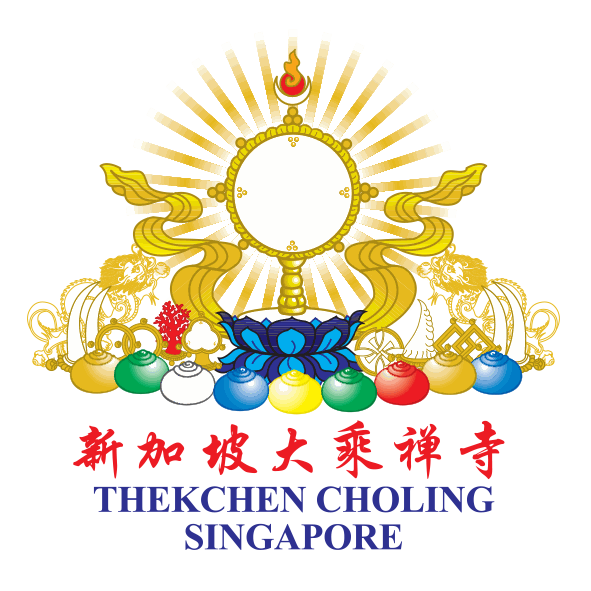
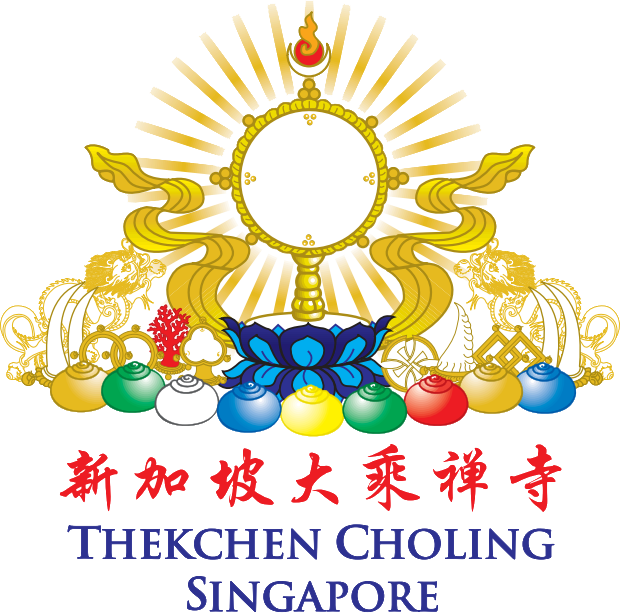
The Sacred Mirror represents consciousness and the element of space. Clear, pure and bright, the mirror reflects all phenomena objectively without bias, thereby reminding us to practice objectivity and to rise above our judgmental minds. On a more subtle level, it reflects the Buddha’s core teaching of emptiness – that nothing exists on its own side without a dependent arising cause.
Pinnacle of the mirror
The pinnacle of the mirror, formed by the white crescent moon, flaming red sun and an orange flame of fire, represents the completion stage of Vajrayana practice.
Light Rays
The light rays radiating from the Sacred Mirror represent the flourishing of the Buddha’s teachings, fanning out to the furthest reaches of the universe.
Full Moon Disc
The moon disc represents Bodhicitta, the aspiration to become a Buddha to benefit all sentient beings.
Blue Lotus
Divinely fragrant, blue lotuses bloomed only in the Buddha’s time. By incorporating it into the temple’s logo, it is symbolic of the ever-present Buddha in Thekchen Choling. Moreover, a lotus flower represents purity, perfection, compassion and renunciation, similar to how the beautiful lotus remains untainted even though it had arisen out from the muddy waters.
Nine Precious Jewels
These nine precious jewels represent the Guru, Buddha, Dharma, Sangha, yidam or mind-seal deity, Dharma protector, the sky, earth, and the human realm.
Two Dragons
The two dragons represent continuity and harmony and create the cause for the temple to enjoy the strong support of members and benefactors for Dharma to flourish.
Golden Khata
The flowing golden khata represents the auspicious increase of all Dharma activities.
The Seven Gems of the Chakravartin or a Wheel-Turning King
1. The precious horse represented by a unicorn’s horn
2. The precious elephant represented by its tusks
3. The precious queen represented by round golden earrings
4. The precious minister represented by square golden earrings
5. The precious general represented by a pair of crossed swords
6. The precious jewel represented by the triple-eyed gem
7. The precious Dharma wheel represented by a branch of coral