“Deja vu moments are conditioned from a previous life’s existence. They are why you can feel so connected to certain places or certain people the first time that they come into your present life.”
In Singha Rinpoche’s experience, one must leave déjà vu moments as they are and place no importance upon them.
Our reincarnation’s purpose is to start again and not pick up from where we left off necessarily. In reconnecting ourselves to previous lives, we also reconnect to the attachments and anger from those lives. Bringing out all of this old samsara will not necessarily have the best outcome.
What is best is to create good connections with all beings now, in this life. We also need to grow and learn how to agree to disagree, so we may maintain our truth as we connect and coexist peacefully and auspiciously with others. To coexist auspiciously means that there is a recognition that whatever we have now is due to a previous life, and it is our wish to bring it forward to a future existence so that it can be of benefit to all beings. So when these deja vu moments occur, use them wisely and think of them in this way.
To form positive relationships with others, we must first be able to like ourselves. Many people who take the Buddhist vows and begin to practice Buddhism start to complain that they see things about themselves that they don’t like. Consider this a blessing. It’s like someone has handed us a bright torchlight so we can see all our rubbish. Complaining about it serves no purpose.
Complaining is a worldly competition that gets us nowhere except to trigger more negative karma. Start clearing it out. Start to purify it. Where you choose to put into your own heart is what matters. Open up your heart, offer your old heart, and start to rejoice. Begin to rejoice in everybody’s goodness. Speak up and appreciate the other. Everybody loves recognition, genuine care, compassion, support, and a good listening ear that does not judge.
The path to enlightenment lies in the practice of the Guru Puja. Commitment, renunciation, generating the aspiration of the spirit of enlightenment, and the right view. All this sums up Guru Puja. When we do any tantric practice, there is always a dissolution of ourselves. The rest is a continuous accumulation of merit, study, and meditation.
Merit is like probiotics, and study is like the food. Meditation is digestion. With these three together, we will be healthy, will grow, and realign in our body, speech, and mind. This way, life after life, we can let everything start anew.
What we have now is what is best. We cannot eat tomorrow’s dinner now, and we cannot replicate the perfect breakfast that we had ten years ago. Life lies in the here and now.
Dharma Teaching by Singha Rinpoche and edited by Sandeep Nath
21 Feb 2021
Sacred Mirror
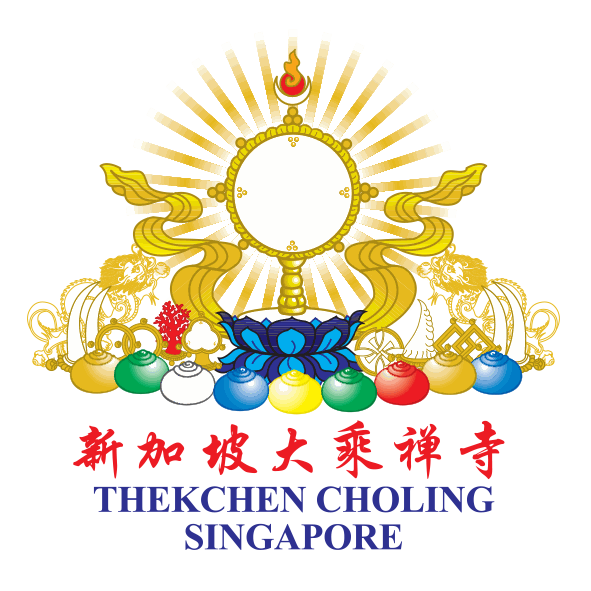
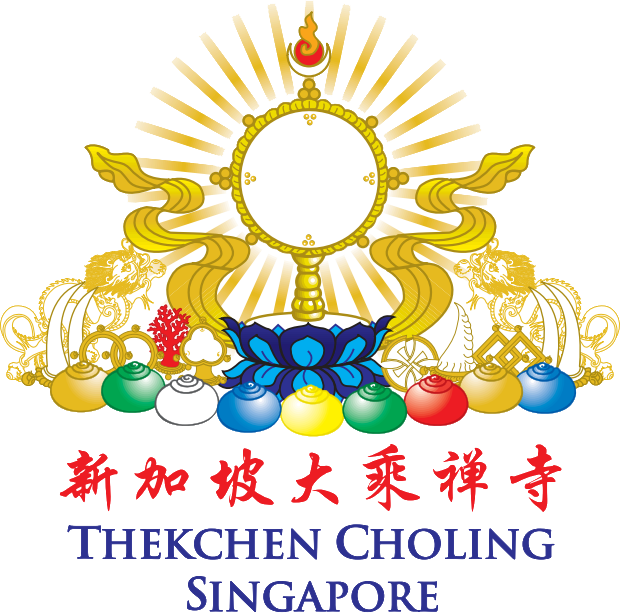
The Sacred Mirror represents consciousness and the element of space. Clear, pure and bright, the mirror reflects all phenomena objectively without bias, thereby reminding us to practice objectivity and to rise above our judgmental minds. On a more subtle level, it reflects the Buddha’s core teaching of emptiness – that nothing exists on its own side without a dependent arising cause.
Pinnacle of the mirror
The pinnacle of the mirror, formed by the white crescent moon, flaming red sun and an orange flame of fire, represents the completion stage of Vajrayana practice.
Light Rays
The light rays radiating from the Sacred Mirror represent the flourishing of the Buddha’s teachings, fanning out to the furthest reaches of the universe.
Full Moon Disc
The moon disc represents Bodhicitta, the aspiration to become a Buddha to benefit all sentient beings.
Blue Lotus
Divinely fragrant, blue lotuses bloomed only in the Buddha’s time. By incorporating it into the temple’s logo, it is symbolic of the ever-present Buddha in Thekchen Choling. Moreover, a lotus flower represents purity, perfection, compassion and renunciation, similar to how the beautiful lotus remains untainted even though it had arisen out from the muddy waters.
Nine Precious Jewels
These nine precious jewels represent the Guru, Buddha, Dharma, Sangha, yidam or mind-seal deity, Dharma protector, the sky, earth, and the human realm.
Two Dragons
The two dragons represent continuity and harmony and create the cause for the temple to enjoy the strong support of members and benefactors for Dharma to flourish.
Golden Khata
The flowing golden khata represents the auspicious increase of all Dharma activities.
The Seven Gems of the Chakravartin or a Wheel-Turning King
1. The precious horse represented by a unicorn’s horn
2. The precious elephant represented by its tusks
3. The precious queen represented by round golden earrings
4. The precious minister represented by square golden earrings
5. The precious general represented by a pair of crossed swords
6. The precious jewel represented by the triple-eyed gem
7. The precious Dharma wheel represented by a branch of coral