
“Tadyatha Om Tathagata Bhagawan Naga Raja Shvara Atisthana Atisthite Svaha” – The ‘King of Nagas’ Mantra.
As you are perhaps aware, Theravada Buddhism is about the practice of self-discipline and suppression. Because there are so many afflictions in samsara, a Theravada practitioner will avoid doing anything wrong. S/he will not create any new causes or activate or ripen any causes of affliction from the past.
In Mahayana Buddhism, the aim is to cultivate a pure perception and purify all of our wrong views because we can purify negative karma. As students and practitioners, we are n our way to realizing the intent of Buddha. To do so, we must have wisdom. And to have wisdom, we need merit.
Theravada clearly shows us that we practice awakening through Vipassana and Samadhi to get out of the cycle of birth and death.
In Mahayana, the most significant seed is that of compassion. It is compassion that compels us to do so many things that ordinarily we would not do. It becomes a striving force to take action that goes beyond just keeping our commitments.
In the Theravada tradition, compassion implies having a kind, peaceful, and gentle aspect. It is the result of many generations of practice.
In Mahayana, compassion is not about being kind and sweet. You also have to have the guts and the skillfulness to teach people or to let people see the nature of their mind to see their “truth.” Hence, we must cultivate compassion, along with wisdom. If not, we create idiot compassion, which can also ignite irreversible and senseless emotions. So wisdom really matters.
When we work on our commitments, if our motive is only to keep the commitment – but not put our heart into our practice – it is a wrong view. We will still accumulate merit, but we will also – in a sense – break the vows of Bodhicitta.
By implication, our next birth may bring us the upper half of a god’s body due to our merit, but the body’s lower half will be like a snake. The top part will have limbs, but the bottom will not. This is the body of a Naga.
And it is the result of our practice to keep commitments – but not for the sake of enlightenment or the awakening of all beings. Therefore, our practice lacks wisdom and compassion, and the remedy is to readjust our motivation as soon as we catch ourselves.
Although Nagas live in natural environments, they suffer from many sicknesses – especially of the skin. Their skin is always sensitive and itchy. And although they are exceptionally meritorious beings, they act instinctively and are easily susceptible to anger, jealousy, and judgementalism.
So think about it. If you tend to have skin problems – or if you encounter a person who exhibits senseless emotional outbursts – you could immediately purify yourself by reciting a mala of the King of Nagas Mantra above.
And increase your mindfulness of both wisdom and compassion.
Dharma Teaching by Singha Rinpoche and edited by Sandeep Nath
14 Feb 2021
Sacred Mirror
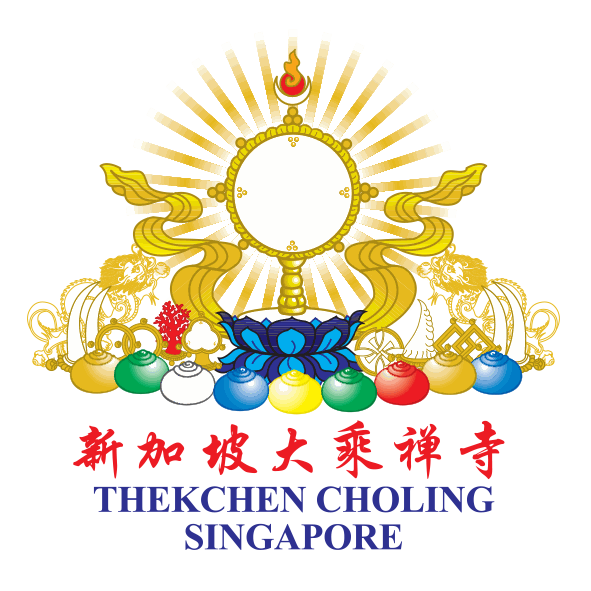
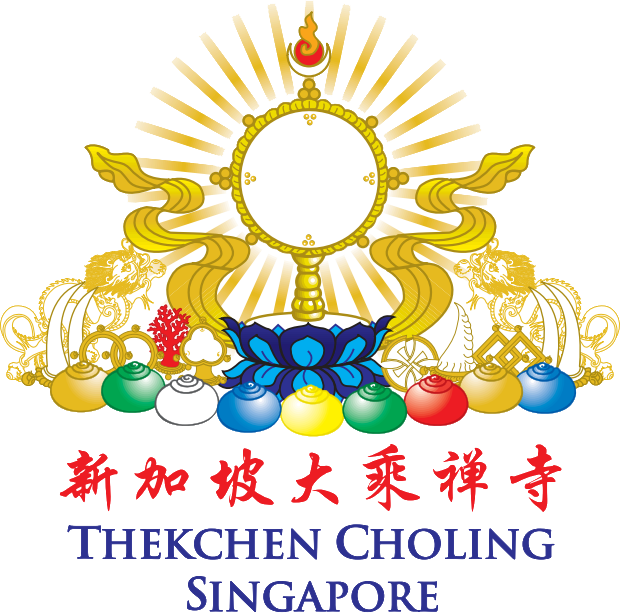
The Sacred Mirror represents consciousness and the element of space. Clear, pure and bright, the mirror reflects all phenomena objectively without bias, thereby reminding us to practice objectivity and to rise above our judgmental minds. On a more subtle level, it reflects the Buddha’s core teaching of emptiness – that nothing exists on its own side without a dependent arising cause.
Pinnacle of the mirror
The pinnacle of the mirror, formed by the white crescent moon, flaming red sun and an orange flame of fire, represents the completion stage of Vajrayana practice.
Light Rays
The light rays radiating from the Sacred Mirror represent the flourishing of the Buddha’s teachings, fanning out to the furthest reaches of the universe.
Full Moon Disc
The moon disc represents Bodhicitta, the aspiration to become a Buddha to benefit all sentient beings.
Blue Lotus
Divinely fragrant, blue lotuses bloomed only in the Buddha’s time. By incorporating it into the temple’s logo, it is symbolic of the ever-present Buddha in Thekchen Choling. Moreover, a lotus flower represents purity, perfection, compassion and renunciation, similar to how the beautiful lotus remains untainted even though it had arisen out from the muddy waters.
Nine Precious Jewels
These nine precious jewels represent the Guru, Buddha, Dharma, Sangha, yidam or mind-seal deity, Dharma protector, the sky, earth, and the human realm.
Two Dragons
The two dragons represent continuity and harmony and create the cause for the temple to enjoy the strong support of members and benefactors for Dharma to flourish.
Golden Khata
The flowing golden khata represents the auspicious increase of all Dharma activities.
The Seven Gems of the Chakravartin or a Wheel-Turning King
1. The precious horse represented by a unicorn’s horn
2. The precious elephant represented by its tusks
3. The precious queen represented by round golden earrings
4. The precious minister represented by square golden earrings
5. The precious general represented by a pair of crossed swords
6. The precious jewel represented by the triple-eyed gem
7. The precious Dharma wheel represented by a branch of coral