
Blog Post 33: Good luck, bad luck and how to solve problems
“We should see everything that is manifesting as a dance of illusion. Very clearly illusion is telling us that when it appears it is very strongly dependent upon cause and effect.”
The truth is, everything that manifests is dependent upon something else. We must accept this. There is no phenomenon that exists by itself and there is no phenomenon that exists with its own concepts. And we don’t have to place labels on everything.
So, the concepts of good luck and bad luck are really subjective. In a situation where our luck is good, but we don’t use it to accumulate greater merit, before we know it, it’s lost. Once it is gone, it will be very clear that we will have regrets. And we will judge, complain, blame, and justify.
But if we really study, meditate, and observe the nature of phenomena, everything that we end up in began through our cravings, delusions, attachments, and expectations. So, if we decide to gauge ourselves in our dharma practice, we must know that it is going in the right direction when our ego is low – for that is lessening wrong views and purifying emotions.
The essence of Buddha’s teaching is about mind training and break throughs. When we can train our mind, we can break through our old karmic habituations. Our idea of good luck and bad luck must evolve. Good luck does not mean that everything goes our way. For that only feeds our ego. And bad luck doesn’t mean everything is against us. For that too is only driven by ego.
When it comes to solving problems, the first thing we need to do is to recognize that we all have problems whether we like them or not. The second thing to remember is that efficiency doesn’t work all of the time. Most of us are trained to be efficient in order to be able to get things done, but sometimes something else is needed. Some things just need time. Or somebody else.
We each have different lives, situations and conditions but we can still sit together to keep each other company. We can all meditate together regardless of where we are in the world. When we meditate together, we can heal our outer world, inner world and also forge relationships with others that are graceful and blessed. The generation of great compassion and wisdom are the two most important things that arise from equanimity. And all of this can only be digested and internalized with the time and effort of meditation.
It’s not always a matter of knowing the best thing to say or the best thing to do. Sometimes we just need to listen and the best way to listen to self is to meditate. Many times. just by listening and being present with other persons can solve their problems because people only need to be seen, heard, and acknowledged.
Dharma Teaching by Singha Rinpoche and edited by Sandeep Nath
25 April 2021
Sacred Mirror
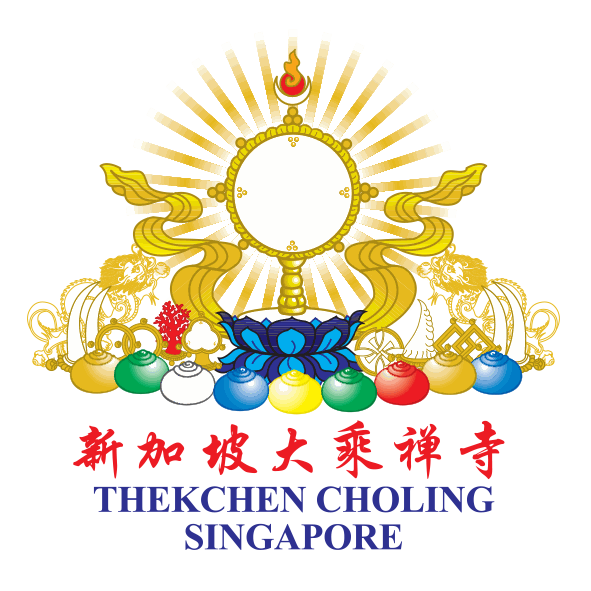
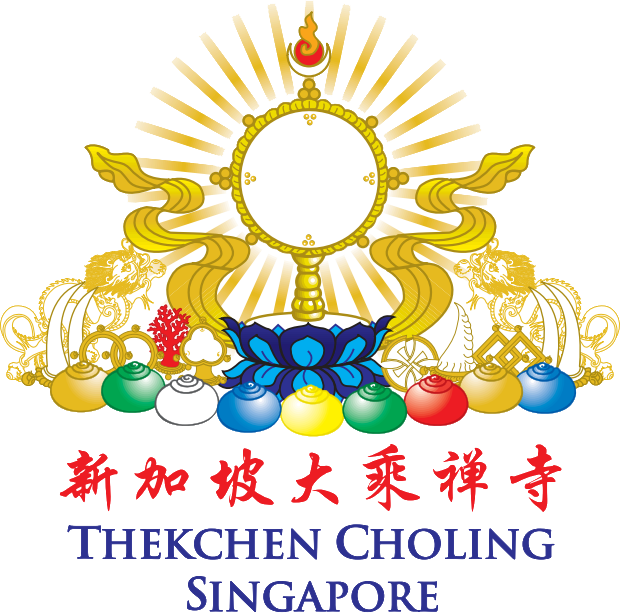
The Sacred Mirror represents consciousness and the element of space. Clear, pure and bright, the mirror reflects all phenomena objectively without bias, thereby reminding us to practice objectivity and to rise above our judgmental minds. On a more subtle level, it reflects the Buddha’s core teaching of emptiness – that nothing exists on its own side without a dependent arising cause.
Pinnacle of the mirror
The pinnacle of the mirror, formed by the white crescent moon, flaming red sun and an orange flame of fire, represents the completion stage of Vajrayana practice.
Light Rays
The light rays radiating from the Sacred Mirror represent the flourishing of the Buddha’s teachings, fanning out to the furthest reaches of the universe.
Full Moon Disc
The moon disc represents Bodhicitta, the aspiration to become a Buddha to benefit all sentient beings.
Blue Lotus
Divinely fragrant, blue lotuses bloomed only in the Buddha’s time. By incorporating it into the temple’s logo, it is symbolic of the ever-present Buddha in Thekchen Choling. Moreover, a lotus flower represents purity, perfection, compassion and renunciation, similar to how the beautiful lotus remains untainted even though it had arisen out from the muddy waters.
Nine Precious Jewels
These nine precious jewels represent the Guru, Buddha, Dharma, Sangha, yidam or mind-seal deity, Dharma protector, the sky, earth, and the human realm.
Two Dragons
The two dragons represent continuity and harmony and create the cause for the temple to enjoy the strong support of members and benefactors for Dharma to flourish.
Golden Khata
The flowing golden khata represents the auspicious increase of all Dharma activities.
The Seven Gems of the Chakravartin or a Wheel-Turning King
1. The precious horse represented by a unicorn’s horn
2. The precious elephant represented by its tusks
3. The precious queen represented by round golden earrings
4. The precious minister represented by square golden earrings
5. The precious general represented by a pair of crossed swords
6. The precious jewel represented by the triple-eyed gem
7. The precious Dharma wheel represented by a branch of coral