
Blog Post 34: Control & Change from a Buddhist Perspective
“Grant me the serenity to accept the things I cannot change, the courage to change the things I can, and the wisdom to know the difference. – Reinhold Niebuhr”
It is important for everybody to understand why to aspire to become a Buddha (the awakened one) and why even bother to study and practice dharma.
At the conventional level, we all like and need to have fun, right? So, what is fun? Let us understand this but examining what is “un-fun”. When things happen to us that we don’t want, we don’t like or that we don’t have control over, that is “un-fun”. Whenever we put a lot of effort into something and don’t get the result we want, that is “un-fun”. There are a lot of things that we just have no control over. We think to be able to have control over things is fun. When the dog listens to our commands, when we strike the lottery, when we get whatever we want; that’s all fun, right? So, it’s fun to be in control.
As the noted American theologian prayed in the quote above, all of the examples cited in the previous para depend on factors outside of us. So, we would do better to look upon their outcomes with serenity. The one thing inside of us is our mind. And dealing with that calls for courage. This courage is our Buddha Nature.
Logically we must easily be in control of our minds but practically we cannot control either our minds or our emotions. And that’s not fun… when our mind goes haywire. It’s not fun when we have wrong views. Our minds are under a great amount of suffering, stress and dissatisfaction, so it’s “un-fun”. The emotions come and we know we should stay calm, we should meditate, that emotions come and go, and all about emptiness. But when our supposed-empty emotions arise, they do not feel as empty as expected. And this is the importance of learning about and understanding Buddha Nature.
Buddha Nature is for us to arouse the spirit of enlightenment within us. We must want to be a Buddha. We cannot hold on to the belief that we are not good enough. Buddha Nature means that we already have this pure heroic aspect, because it is in each one of us. This Buddha Nature within us is just screaming to come out but we have to learn something about compassion, empathy, wisdom and action. If not, we will always just be someone who cannot – or someone who does not – feel enough confidence to go forward.
It is because of Buddha Nature that we have humility. We have a mutual respect for one another and we see the light in each other. When we band together, we are the light. We realize that alone we are a spark but together we are the light. We give hope. And we don’t have to discover it. Just let it self-arise!
Dharma Teaching by Singha Rinpoche and edited by Sandeep Nath
2 May 2021
Sacred Mirror
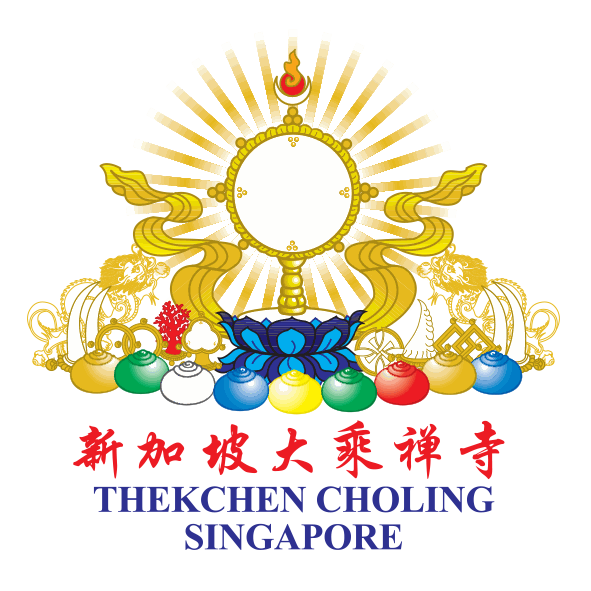
The Sacred Mirror represents consciousness and the element of space. Clear, pure and bright, the mirror reflects all phenomena objectively without bias, thereby reminding us to practice objectivity and to rise above our judgmental minds. On a more subtle level, it reflects the Buddha’s core teaching of emptiness – that nothing exists on its own side without a dependent arising cause.
Pinnacle of the mirror
The pinnacle of the mirror, formed by the white crescent moon, flaming red sun and an orange flame of fire, represents the completion stage of Vajrayana practice.
Light Rays
The light rays radiating from the Sacred Mirror represent the flourishing of the Buddha’s teachings, fanning out to the furthest reaches of the universe.
Full Moon Disc
The moon disc represents Bodhicitta, the aspiration to become a Buddha to benefit all sentient beings.
Blue Lotus
Divinely fragrant, blue lotuses bloomed only in the Buddha’s time. By incorporating it into the temple’s logo, it is symbolic of the ever-present Buddha in Thekchen Choling. Moreover, a lotus flower represents purity, perfection, compassion and renunciation, similar to how the beautiful lotus remains untainted even though it had arisen out from the muddy waters.
Nine Precious Jewels
These nine precious jewels represent the Guru, Buddha, Dharma, Sangha, yidam or mind-seal deity, Dharma protector, the sky, earth, and the human realm.
Two Dragons
The two dragons represent continuity and harmony and create the cause for the temple to enjoy the strong support of members and benefactors for Dharma to flourish.
Golden Khata
The flowing golden khata represents the auspicious increase of all Dharma activities.
The Seven Gems of the Chakravartin or a Wheel-Turning King
1. The precious horse represented by a unicorn’s horn
2. The precious elephant represented by its tusks
3. The precious queen represented by round golden earrings
4. The precious minister represented by square golden earrings
5. The precious general represented by a pair of crossed swords
6. The precious jewel represented by the triple-eyed gem
7. The precious Dharma wheel represented by a branch of coral