“As human beings, we are seldom taught to recognize and acknowledge the divine nature in others. When we say ‘Hello,’ we merely touch on acknowledging the other’s presence.”
The root of The Eight Worldly Concerns is in our self-cherishing thoughts. But it boils down to self-love. We all want to be famous and outstanding in our way. Self-love is what we need to have so that we can bring such fulfillment into our lives.
We have to put our hearts and souls into our practice – with self-love and faith. We have to ask ourselves whether we do things only for recognition and fame, or is our heart in the right place? Is what we do giving us inner joy and inner pride?
A real sense of inner pride shows confidence. Having confidence is not the same as having an ego. When we are confident about something, we are calm. Ego is when we need to show off. The very best confidence we can have is when we live fully every day and are ready to die at any time. When we know how to deal with the physical death of the body, that is real confidence. The human mind passes along with the human body, but consciousness is eternal.
When our practice becomes second nature, there is no reason to do anything for fame, wealth, or honor, to show off, or prove anything to anybody. When it becomes an inner bliss, we have the fulfillment of heart. Our hearts can become bigger, greater, and more spacious. A great heart is a big heart that can accommodate all beings. And greet them with proper acknowledgment.
When we put our hands together and say “Namaste,” it means that I pay homage to the divine in you. The divine is the Buddha-nature. We recognize that there is a spiritual being within every human body.
Tashi Delek has an even deeper meaning. When we greet our Guru in this way, we see the Guru as Buddha and receive all of the Buddha’s blessings and inspiration. When we can see all beings like Buddha, that is the best. However, it is difficult because we have an ego to conquer. Most of the time, the “I” becomes the most important thing. We are so full of ourselves; we can only see what we want to see. And this creates the cycle of samsara.
The book, The Foundation of All Good Qualities, talks about how we suffer and don’t get to awakening or enlightenment because of wrong view. Wrong view is based on self-cherishing and not upon self-love. Self-love is an inner bliss that brings us closer to our awakening. It is not based upon recognition or acceptance by others. It is beyond worldly dharma.
To summarize, the connection is that our Namaste reminds us of our mutual divinity and cuts our ego. And that fuels our inner bliss, resulting in confidence to achieve all we want, with self-love devoid of self-cherishing.
Dharma Teaching by Singha Rinpoche and edited by Sandeep Nath
24 Jan 2021
Sacred Mirror
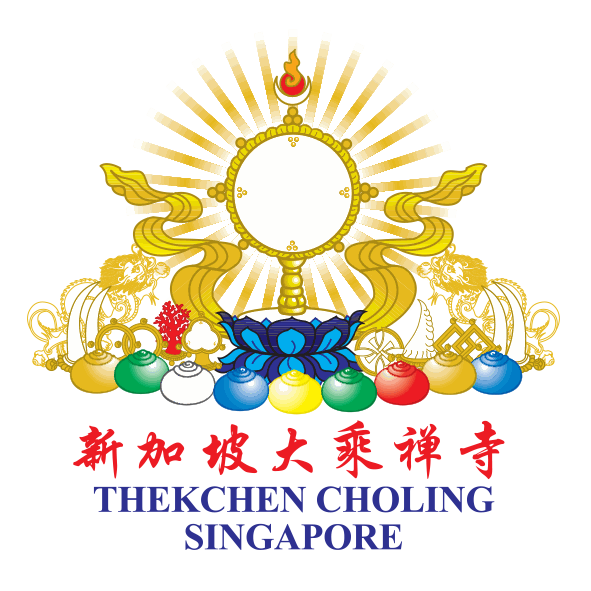
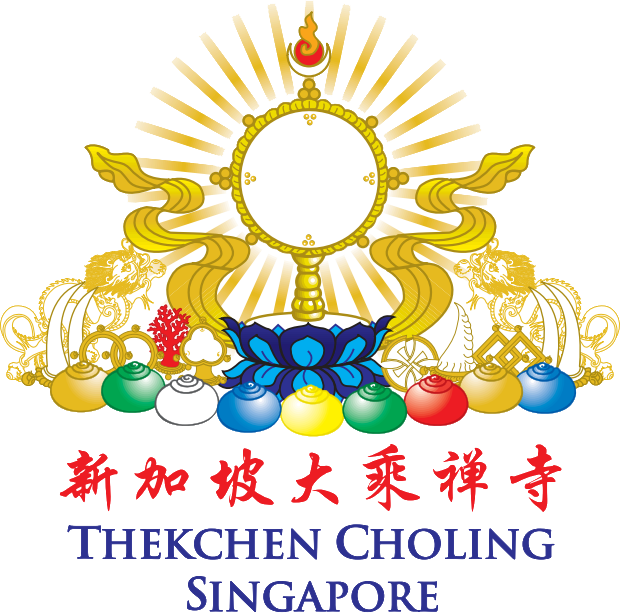
The Sacred Mirror represents consciousness and the element of space. Clear, pure and bright, the mirror reflects all phenomena objectively without bias, thereby reminding us to practice objectivity and to rise above our judgmental minds. On a more subtle level, it reflects the Buddha’s core teaching of emptiness – that nothing exists on its own side without a dependent arising cause.
Pinnacle of the mirror
The pinnacle of the mirror, formed by the white crescent moon, flaming red sun and an orange flame of fire, represents the completion stage of Vajrayana practice.
Light Rays
The light rays radiating from the Sacred Mirror represent the flourishing of the Buddha’s teachings, fanning out to the furthest reaches of the universe.
Full Moon Disc
The moon disc represents Bodhicitta, the aspiration to become a Buddha to benefit all sentient beings.
Blue Lotus
Divinely fragrant, blue lotuses bloomed only in the Buddha’s time. By incorporating it into the temple’s logo, it is symbolic of the ever-present Buddha in Thekchen Choling. Moreover, a lotus flower represents purity, perfection, compassion and renunciation, similar to how the beautiful lotus remains untainted even though it had arisen out from the muddy waters.
Nine Precious Jewels
These nine precious jewels represent the Guru, Buddha, Dharma, Sangha, yidam or mind-seal deity, Dharma protector, the sky, earth, and the human realm.
Two Dragons
The two dragons represent continuity and harmony and create the cause for the temple to enjoy the strong support of members and benefactors for Dharma to flourish.
Golden Khata
The flowing golden khata represents the auspicious increase of all Dharma activities.
The Seven Gems of the Chakravartin or a Wheel-Turning King
1. The precious horse represented by a unicorn’s horn
2. The precious elephant represented by its tusks
3. The precious queen represented by round golden earrings
4. The precious minister represented by square golden earrings
5. The precious general represented by a pair of crossed swords
6. The precious jewel represented by the triple-eyed gem
7. The precious Dharma wheel represented by a branch of coral