
“Real dharma practice will always hurt the illusive “us,” the ego. The result of receiving such hurt is the generation of humility and compassion.”
We live in an illusory world, but this is not an illusion at all for many of us. It is the real world. We have bills to pay; we have to eat; we have to sleep in a bed under a roof. There is no such thing as saying that it’s an illusion because everything we experience has a real effect. So in such a world, what can we practice to make ourselves better?
We all have problems, we have sickness, we have desires, and we have cravings. Many times it is our offensive speech habits that can trigger these circumstances. We each come from different backgrounds, and we have various karmic conditions. Therefore, the main thing is that we must have respect for one another. Talking down to people or negatively asking for attention does not benefit anyone in the long run. In fact, it hurts.
There are four ways to go, as per the Buddha. The first way is through our generosity. Whether it’s material generosity or the generosity of your time, it’s a generosity intended to meet other beings’ needs.
The second is in having skillful speech. Here you adjust the conversation so that it is beneficial to the person who is receiving it. It’s about having mutual respect and honoring each other’s space by not making others feel tense or feel stupid or uncomfortable because that kind of behavior is bullying.
The third is giving good advice, which means being skillful with your speech and not engaging in gossiping.
The fourth is by practicing what you preach kindly. The essence of this is in having compassion for others because the root of Mahayana is compassion.
A bodhisattva’s empathy means to have a heart of compassion. It’s to know other people’s suffering and to experience it, but not to drown oneself in it. The real activity of dharma, practiced in this way in our lives, can matter in this conditional world.
Small-minded people will talk about other people. Average people like to talk about events. Great-minded people with aspirations speak about ideas and concepts and then discuss them and support each other to make things happen. So think about yourself. Which of these three describes your everyday talk? And forgive yourself for having made mistakes because we are all still a work in progress.
The most important practice for sustainable and beneficial results is that of Guru Yoga. The Guru manifests as such, karmically, to us because we need cleansing. We need to return everything to their source. Return the thoughts to their source. Return the elements to their source. So there is nothing left for our egos to hold.
Dharma Teaching by Singha Rinpoche and Edited by Sandeep Nath
17 Jan 2021
Sacred Mirror
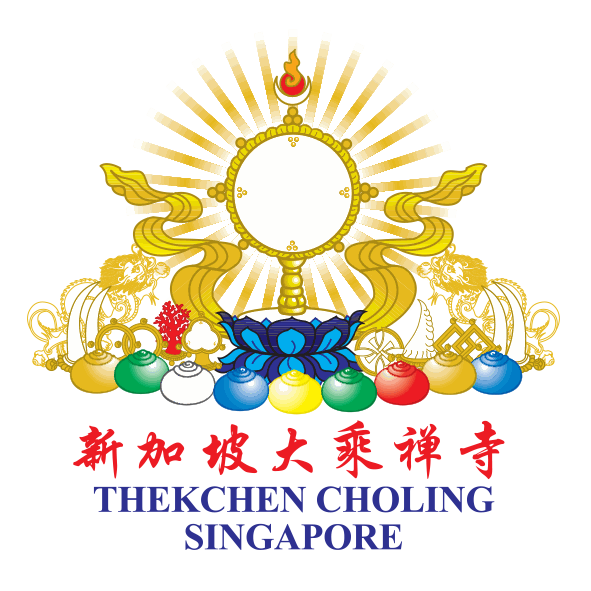
The Sacred Mirror represents consciousness and the element of space. Clear, pure and bright, the mirror reflects all phenomena objectively without bias, thereby reminding us to practice objectivity and to rise above our judgmental minds. On a more subtle level, it reflects the Buddha’s core teaching of emptiness – that nothing exists on its own side without a dependent arising cause.
Pinnacle of the mirror
The pinnacle of the mirror, formed by the white crescent moon, flaming red sun and an orange flame of fire, represents the completion stage of Vajrayana practice.
Light Rays
The light rays radiating from the Sacred Mirror represent the flourishing of the Buddha’s teachings, fanning out to the furthest reaches of the universe.
Full Moon Disc
The moon disc represents Bodhicitta, the aspiration to become a Buddha to benefit all sentient beings.
Blue Lotus
Divinely fragrant, blue lotuses bloomed only in the Buddha’s time. By incorporating it into the temple’s logo, it is symbolic of the ever-present Buddha in Thekchen Choling. Moreover, a lotus flower represents purity, perfection, compassion and renunciation, similar to how the beautiful lotus remains untainted even though it had arisen out from the muddy waters.
Nine Precious Jewels
These nine precious jewels represent the Guru, Buddha, Dharma, Sangha, yidam or mind-seal deity, Dharma protector, the sky, earth, and the human realm.
Two Dragons
The two dragons represent continuity and harmony and create the cause for the temple to enjoy the strong support of members and benefactors for Dharma to flourish.
Golden Khata
The flowing golden khata represents the auspicious increase of all Dharma activities.
The Seven Gems of the Chakravartin or a Wheel-Turning King
1. The precious horse represented by a unicorn’s horn
2. The precious elephant represented by its tusks
3. The precious queen represented by round golden earrings
4. The precious minister represented by square golden earrings
5. The precious general represented by a pair of crossed swords
6. The precious jewel represented by the triple-eyed gem
7. The precious Dharma wheel represented by a branch of coral