

Many of us have studied a lot of dharma. We have had our own experiences. And sometimes we get drowned in those experiences. We fail to see whatever we are experiencing as an expression of our dharma practice.
When we encounter difficult situations, we must refrain from becoming emotional and over reactive. We must train to be like detectives because we need to be able to see beyond just the way things appear to us. Here are three steps to do that.
First, we should practice protecting our minds so that they do not become stained by ego, self-cherishing, praise & blame, and gifts & honor. We are so used to reacting to everything immediately. We are too quick to judge and to place blame. We need to be able to stop and to determine the real motive behind what just happened.
Next, we must think about how the experience could be spiritually enriching. Many people might examine lessons, but only thinking samsarically. Because in learning something, we do gain the weight of carrying more mental baggage. Whatever the situation, we should see and study how it affects our being as a whole, and not just our “I.” Identity is only the mental fixation of who we believe we are.
And lastly, we must train and believe that we are a future Buddha because we indeed are. A Buddha is only an emanation and a manifestation of your enlightened mind. Of course, there are different levels of enlightenedness, but a wise person is considered wise because other people recognize his or her activity of sharing knowledge, experience, and wisdom.
So manifest and give your Buddha-ness, your love, support, compassion, kindness, your listening ear, your friendliness, and your loveliness. Manifest connectedness because we need to connect for life to become meaningful. If there is no connection, there is just you and me. When there is a connection, then we are one without even the need to say it. So manifest the Buddha in you.
All beings have their own nature, and that very nature comes from our previous lives. So don’t always believe in your own realizations and don’t always believe in the realizations of others. You can listen and observe, and if these realizations help you to have your own “a-ha moment,” that’s awesome. But we must probe deeper to see whether these realizations are helping us overcome our emotions, our thoughts, and our egos. Trust your Buddha nature and let it grow. Listen to others in a way not just to give them advice but in a way that supports them in manifesting their own enlightened aspects.
We may all have gained some worldly success, but check this; did our minds and hearts evolve and transform into something bigger and better? Introspect this to look for clues. Connect them. And presto! You will become a dharma detective!
Dharma Teaching by Singha Rinpoche & Edited by Sandeep Nath
13 Sep 2020
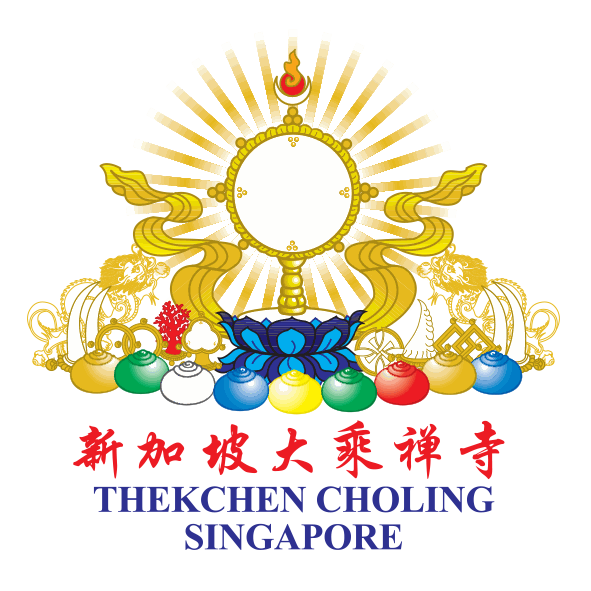
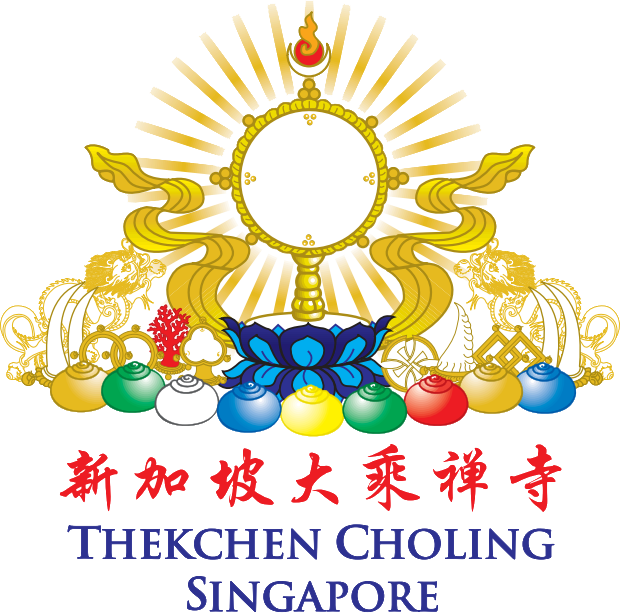
Sacred Mirror
The Sacred Mirror represents consciousness and the element of space. Clear, pure and bright, the mirror reflects all phenomena objectively without bias, thereby reminding us to practice objectivity and to rise above our judgmental minds. On a more subtle level, it reflects the Buddha’s core teaching of emptiness – that nothing exists on its own side without a dependent arising cause.
Pinnacle of the mirror
The pinnacle of the mirror, formed by the white crescent moon, flaming red sun and an orange flame of fire, represents the completion stage of Vajrayana practice.
Light Rays
The light rays radiating from the Sacred Mirror represent the flourishing of the Buddha’s teachings, fanning out to the furthest reaches of the universe.
Full Moon Disc
The moon disc represents Bodhicitta, the aspiration to become a Buddha to benefit all sentient beings.
Blue Lotus
Divinely fragrant, blue lotuses bloomed only in the Buddha’s time. By incorporating it into the temple’s logo, it is symbolic of the ever-present Buddha in Thekchen Choling. Moreover, a lotus flower represents purity, perfection, compassion and renunciation, similar to how the beautiful lotus remains untainted even though it had arisen out from the muddy waters.
Nine Precious Jewels
These nine precious jewels represent the Guru, Buddha, Dharma, Sangha, yidam or mind-seal deity, Dharma protector, the sky, earth, and the human realm.
Two Dragons
The two dragons represent continuity and harmony and create the cause for the temple to enjoy the strong support of members and benefactors for Dharma to flourish.
Golden Khata
The flowing golden khata represents the auspicious increase of all Dharma activities.
The Seven Gems of the Chakravartin or a Wheel-Turning King
1. The precious horse represented by a unicorn’s horn
2. The precious elephant represented by its tusks
3. The precious queen represented by round golden earrings
4. The precious minister represented by square golden earrings
5. The precious general represented by a pair of crossed swords
6. The precious jewel represented by the triple-eyed gem
7. The precious Dharma wheel represented by a branch of coral