“What happened,” you ask?
“Awareness happened,” I say.
We have taken our lives so much for granted in terms of having good food, electricity, water, transportation, gas, etc. All this is on the outside. And when you are on the outside, you tend to run around blaming and bullying others.
But when you are in lockdown, you are alone. You are in your world, and you start to see the truth about yourself. There is no one to blame but yourself.
You see, the things that we keep inside of us, in our hearts and our minds, are all of the bad memories, the anger, the jealousy, the gossip, and the wrong views. Similarly, no matter how beautiful samsara appears sometimes, we all know that it is polluted.
The reality is that there are many viruses and bacteria everywhere. We don’t know when we may get sick. We don’t know when or how we are going to die. So, to protect our bodies, we should do the practices of building our body’s immunity and not just blindly chase our outer world. We must become more aware.
We should use the experience to purify our negative karma and to correct our wrong views. In purifying our negative karma, we will naturally become more aware. With awareness, we will start to make choices that are not just out of convenience but out of compassion.
In times like this, we can also think about how fortunate we are. Are we ever going to cherish what we have now? If you happen to meet up with a farmer, thank that farmer. We need to be grateful. And what about the trash collectors and all of those who clean up after us? We need to thank them too. Use this situation to appreciate these things. Thank the doctors, nurses, delivery boys, and so many other people who are on the front lines for us.
With so much fear and so much insecurity, we have an excellent opportunity for practicing compassion. When you cannot go out and do anything, the best thing to do is overcome yourself. Our focus should be upon providing genuine loving-kindness for all other beings. Be a loving and kind practitioner. When somebody needs their hand to be held, hold their hand. When somebody needs a hug, hug them. When somebody is crying, lend them support. To be at ease with an inner serenity is what is most important.
In our practice, it is our choice to see the good in others. We need to meditate every day, and we need to exercise good mental and spiritual hygiene.
Compassion with wisdom is what is most important. We need to cultivate wisdom. Wisdom is the thing that will help us to see, to appreciate, to cherish, and to cognize. When you can see, and you can experience samsara as it is, then you will start to make better choices.
Dharma Teaching by Singha Rinpoche & Edited by Sandeep Nath
20 September 2020
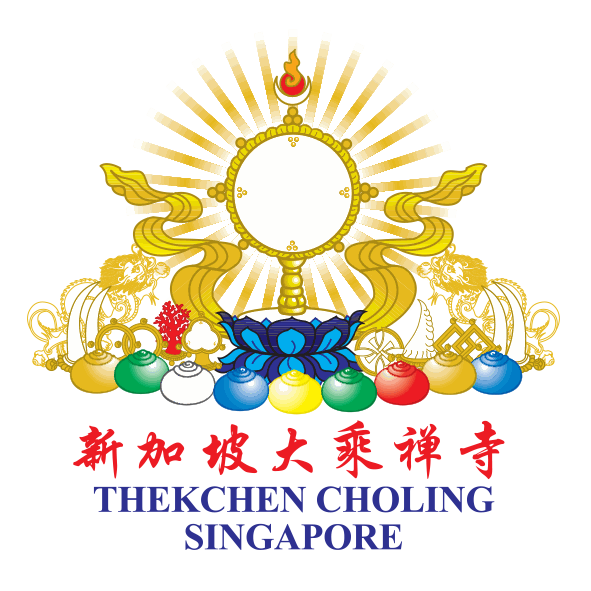
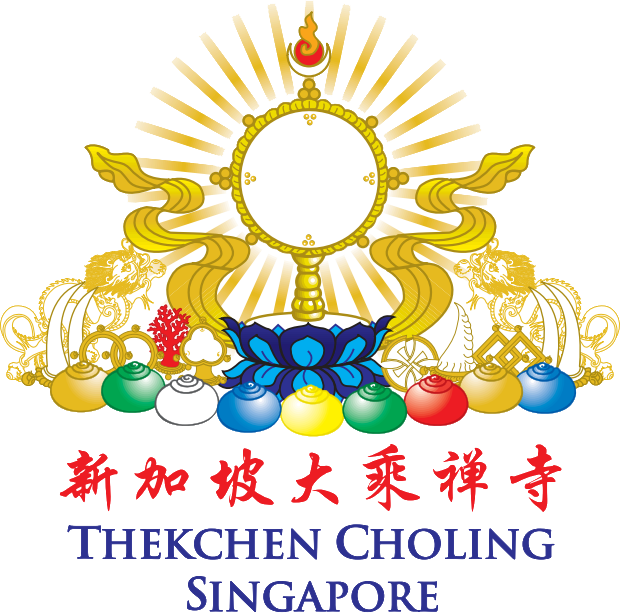
Sacred Mirror
The Sacred Mirror represents consciousness and the element of space. Clear, pure and bright, the mirror reflects all phenomena objectively without bias, thereby reminding us to practice objectivity and to rise above our judgmental minds. On a more subtle level, it reflects the Buddha’s core teaching of emptiness – that nothing exists on its own side without a dependent arising cause.
Pinnacle of the mirror
The pinnacle of the mirror, formed by the white crescent moon, flaming red sun and an orange flame of fire, represents the completion stage of Vajrayana practice.
Light Rays
The light rays radiating from the Sacred Mirror represent the flourishing of the Buddha’s teachings, fanning out to the furthest reaches of the universe.
Full Moon Disc
The moon disc represents Bodhicitta, the aspiration to become a Buddha to benefit all sentient beings.
Blue Lotus
Divinely fragrant, blue lotuses bloomed only in the Buddha’s time. By incorporating it into the temple’s logo, it is symbolic of the ever-present Buddha in Thekchen Choling. Moreover, a lotus flower represents purity, perfection, compassion and renunciation, similar to how the beautiful lotus remains untainted even though it had arisen out from the muddy waters.
Nine Precious Jewels
These nine precious jewels represent the Guru, Buddha, Dharma, Sangha, yidam or mind-seal deity, Dharma protector, the sky, earth, and the human realm.
Two Dragons
The two dragons represent continuity and harmony and create the cause for the temple to enjoy the strong support of members and benefactors for Dharma to flourish.
Golden Khata
The flowing golden khata represents the auspicious increase of all Dharma activities.
The Seven Gems of the Chakravartin or a Wheel-Turning King
1. The precious horse represented by a unicorn’s horn
2. The precious elephant represented by its tusks
3. The precious queen represented by round golden earrings
4. The precious minister represented by square golden earrings
5. The precious general represented by a pair of crossed swords
6. The precious jewel represented by the triple-eyed gem
7. The precious Dharma wheel represented by a branch of coral