“What it means to take our vows and the importance – and ways – of repairing broken vows.”
Last week we learned about the significance of making vows to the outer and inner gurus. Lay people that we are, we are naturally prone to breaking them. And the consequence is ‘Vajra hell.’ So how do we avoid that?
Here are the four conditions – which, if we fulfill – we break a vow fully.
First, we have to be aware of the vow and have to choose to break it consciously.
Second, we must think it justified to repeat that action. For example, if in a fit of anger, we break a vow. Later we recognize that we were caught in emotion and lost control, but we have no regret for having done so. In such a case, we meet this second condition.
The third condition is that we feel happy to have broken the vow.
And fourth is to have no consideration of breaking the vow. Instead, to feel a sense of shamelessness about having done so.
To fulfill all of these four conditions is not easy. Generally, when we break a vow, we feel quite uncomfortable and want to seek forgiveness and restore it.
Having said that, we must appreciate that practicing dharma is not easy either, and it is not comfortable. We live in samsara – where people think of everything only in terms of time and money. Dharma has a value that is beyond time or any amount of money. The value of us being here to be a better version of ourselves is like a wish-fulfilling jewel. The real question is, can we put down our ego to sit down to listen to our Gurus and put our heart on the floor?
Vajra hell is not a place we reach after death. When we hold extreme wrong views and have lost control of our minds, that is a vajra hell. The best control for us here and now is to become comfortable with being in the present. To appreciate the present moment instead of quarreling about the past or the future.
We must cherish the present rather than remember all of the unhappy moments because these bad habits cause our mental suffering, feelings of loss, depression, and fear. That can be a vajra hell. Our ego can also cause immense vajra hell when we can only think about ourselves and have no concern for others.
When we break vows, we break the samaya bond with all of the Buddhas and Gurus. Doing so can cause the mind to become unstable as we lose the connection with our Buddha nature. And we enter Vajra Hell.
Vows can be broken by choice or by conditions. Choice is intentional. However, conditions are not –and we can dare to admit that we have broken a vow, faltered, and are genuinely sorry.
Such is dharma practice too. So if we have broken our vows, we always need to restore them, move on, build upon them, and then be happy about it. Forever in the present moment.
Dharma Teaching by Singha Rinpoche and edited by Sandeep Nath
7 Feb 2021
Sacred Mirror
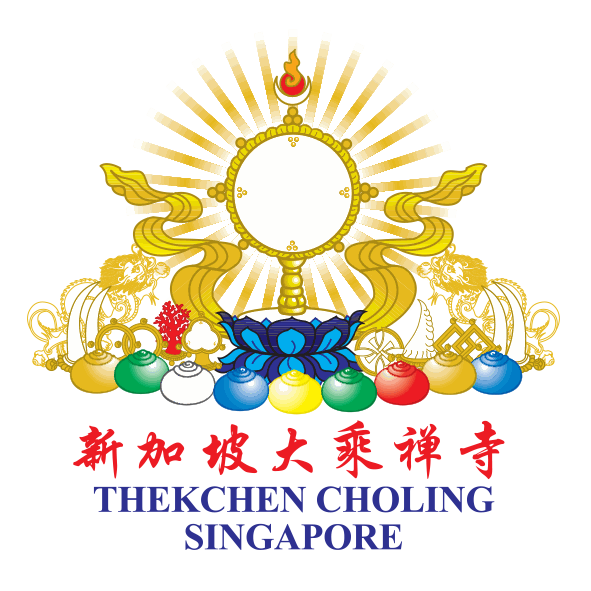
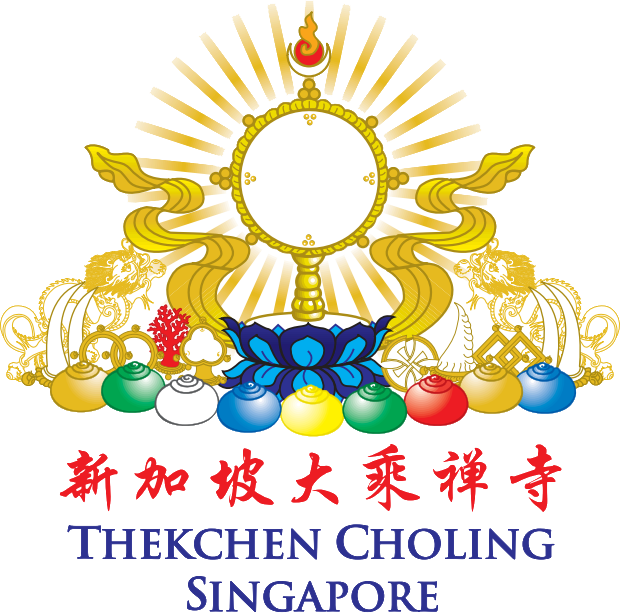
The Sacred Mirror represents consciousness and the element of space. Clear, pure and bright, the mirror reflects all phenomena objectively without bias, thereby reminding us to practice objectivity and to rise above our judgmental minds. On a more subtle level, it reflects the Buddha’s core teaching of emptiness – that nothing exists on its own side without a dependent arising cause.
Pinnacle of the mirror
The pinnacle of the mirror, formed by the white crescent moon, flaming red sun and an orange flame of fire, represents the completion stage of Vajrayana practice.
Light Rays
The light rays radiating from the Sacred Mirror represent the flourishing of the Buddha’s teachings, fanning out to the furthest reaches of the universe.
Full Moon Disc
The moon disc represents Bodhicitta, the aspiration to become a Buddha to benefit all sentient beings.
Blue Lotus
Divinely fragrant, blue lotuses bloomed only in the Buddha’s time. By incorporating it into the temple’s logo, it is symbolic of the ever-present Buddha in Thekchen Choling. Moreover, a lotus flower represents purity, perfection, compassion and renunciation, similar to how the beautiful lotus remains untainted even though it had arisen out from the muddy waters.
Nine Precious Jewels
These nine precious jewels represent the Guru, Buddha, Dharma, Sangha, yidam or mind-seal deity, Dharma protector, the sky, earth, and the human realm.
Two Dragons
The two dragons represent continuity and harmony and create the cause for the temple to enjoy the strong support of members and benefactors for Dharma to flourish.
Golden Khata
The flowing golden khata represents the auspicious increase of all Dharma activities.
The Seven Gems of the Chakravartin or a Wheel-Turning King
1. The precious horse represented by a unicorn’s horn
2. The precious elephant represented by its tusks
3. The precious queen represented by round golden earrings
4. The precious minister represented by square golden earrings
5. The precious general represented by a pair of crossed swords
6. The precious jewel represented by the triple-eyed gem
7. The precious Dharma wheel represented by a branch of coral