
“The Truth of Suffering was the first teaching taught by Lord Shakyamuni Buddha.”
If we look at our current situation of COVID-19, there is a lot of fear, worry, depression, and uncertainty in the whole world. Everybody is feeling the same thing. So let us first set a Buddhist intention that we all want to be free from the cycle of birth and death and ultimately become awakened to perfect Buddhas ourselves.
In the beginning, this intent is lovely, but somewhere in the middle, things get screwed up by conditions, and therefore the results are not always exactly what we want. This is called the truth of suffering. Look at each of us now. We thought that everything was going well, but now we have this situation. So we ask, “Why me?” and then we have to move on to ask, “Why not me?”
What triggers us to say “why me” is our ego. We have to see that this COVID-19 is very kind to all of us now. It affects all of us, affecting anyone at any time. It is the best living example of why we all need to protect our minds. We also need to take the necessary precautions to protect our bodies. So it’s essential to cultivate meditation and some physical and mental discipline.
The beginning of awakening always starts with pain. It can be physical pain or mental suffering. If our minds cannot be calmed and subdued, if we cannot make everything smooth and we are still always chasing after something, then we know that we are not yet enlightened. Enlightenment is like one tight slap of awareness. It’s the mind that is free from everything, which takes constant and consistent effort and purification.
Why is it that we all are suffering? It is so that we can all grow greater than ourselves. So that you can connect with your friends and neighbors, and support one another. There is no point in being a Buddha if there is no one to help. But before all of the mantras, the recitations, pujas, meditation, and refuge, your mind needs to have the thoughts that connect you to all sentient beings.
We have suddenly realized how human connection is such an important thing. So think about it and be grateful for this challenging time. We thought some things were perfect, and now the underlying imperfection of them is manifesting out. All that we thought was good is not a long-lasting good. What is a long-lasting good? It’s your good heart, your perseverance, and your love. So now it is no longer “why me” or even “why not me,” it’s in accepting everything that comes.
Dharma Teaching by Singha Rinpoche & Edited by Sandeep Nath
4 October 2020
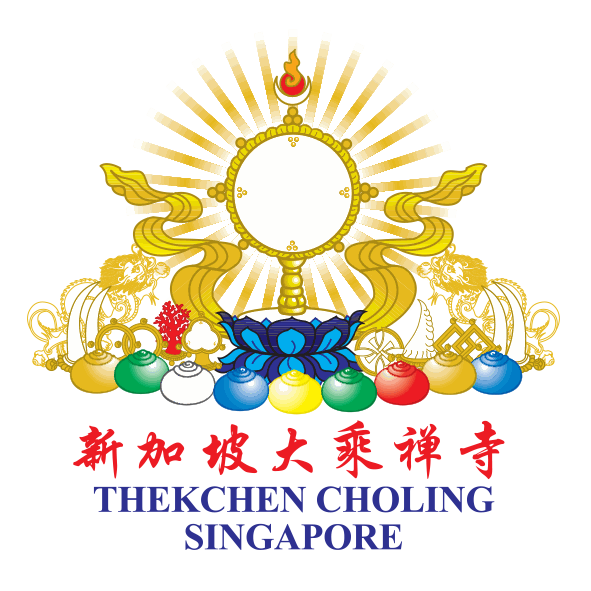
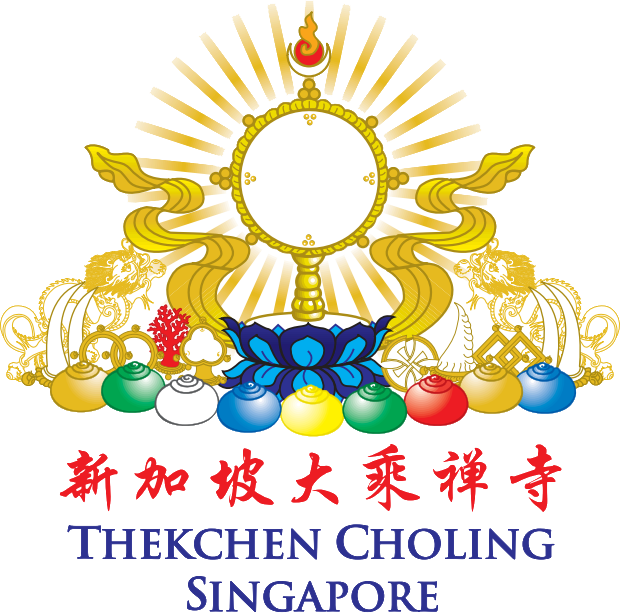
Sacred Mirror
The Sacred Mirror represents consciousness and the element of space. Clear, pure and bright, the mirror reflects all phenomena objectively without bias, thereby reminding us to practice objectivity and to rise above our judgmental minds. On a more subtle level, it reflects the Buddha’s core teaching of emptiness – that nothing exists on its own side without a dependent arising cause.
Pinnacle of the mirror
The pinnacle of the mirror, formed by the white crescent moon, flaming red sun and an orange flame of fire, represents the completion stage of Vajrayana practice.
Light Rays
The light rays radiating from the Sacred Mirror represent the flourishing of the Buddha’s teachings, fanning out to the furthest reaches of the universe.
Full Moon Disc
The moon disc represents Bodhicitta, the aspiration to become a Buddha to benefit all sentient beings.
Blue Lotus
Divinely fragrant, blue lotuses bloomed only in the Buddha’s time. By incorporating it into the temple’s logo, it is symbolic of the ever-present Buddha in Thekchen Choling. Moreover, a lotus flower represents purity, perfection, compassion and renunciation, similar to how the beautiful lotus remains untainted even though it had arisen out from the muddy waters.
Nine Precious Jewels
These nine precious jewels represent the Guru, Buddha, Dharma, Sangha, yidam or mind-seal deity, Dharma protector, the sky, earth, and the human realm.
Two Dragons
The two dragons represent continuity and harmony and create the cause for the temple to enjoy the strong support of members and benefactors for Dharma to flourish.
Golden Khata
The flowing golden khata represents the auspicious increase of all Dharma activities.
The Seven Gems of the Chakravartin or a Wheel-Turning King
1. The precious horse represented by a unicorn’s horn
2. The precious elephant represented by its tusks
3. The precious queen represented by round golden earrings
4. The precious minister represented by square golden earrings
5. The precious general represented by a pair of crossed swords
6. The precious jewel represented by the triple-eyed gem
7. The precious Dharma wheel represented by a branch of coral