“How to view all phenomena and how to view others.”
In Buddhism, we say that everything is emptiness, but that emptiness is not the same as nothingness. When everything is empty, why isn’t it nothing? Empty means that it’s not truly existent, but that doesn’t mean that it doesn’t exist. When we say that something is not truly existent, it just means that it is dependent upon something else to exist as it is. We think that everything, including ourselves, truly exists, but actually, nothing exists independently.
When you look up into the sky, sometimes you see a rainbow, but you do not always see it. The rainbow only appears based upon whether or not the conditions that allow the rainbow to appear are present. Those conditions are the proper light, humidity, water droplets, and the angle of the sun all being there in a certain way to form the rainbow. We think that seeing a rainbow is an auspicious event, but as a dharma practitioner, the real meaning of auspicious is the ability to see beyond that. It’s when we can see that everything exists by its own conditional phenomena, by relying upon something else that allows it to become as it is, for as long as it can be.
What you can see is considered external phenomena, but what about the phenomena of self and others? When you look at others, what do you see? How do you perceive them? We usually cannot perceive anything. We can only understand things through learning. The eye is doing the seeing, but something else is telling the mind what you are seeing. Your eyes, your ears, your mind, and your experiences are all working together to give you this information. The mind on its own, working independently, cannot see, hear or smell, so cognition does not happen with only using one’s sense of seeing something. Our experiences and knowledge also come into play. Seeing is not always believing, and hearing is not always the truth. Those are all perceptions of yourself or of others. There is nothing that is truly trustworthy in samsara.
The main thing we should do as practitioners is to observe the nature of the mind. You can check your mind, but how can you trust your mind? Your own mind is based upon your own perceptions and beliefs. Can we drop the hearing, drop seeing, drop smelling, tasting, and feeling and simply be a vast space?
The Buddha-nature mind is clear, and it is omnipresent, but we choose to focus on the small stuff. We should perceive externally with people and with phenomena and internally with ourselves / our own mind, every moment as it is. Be there and live to enjoy every moment as it is.Dharma Teaching by Singha Rinpoche & Edited by Sandeep Nath
27 Sep 2020
Sacred Mirror
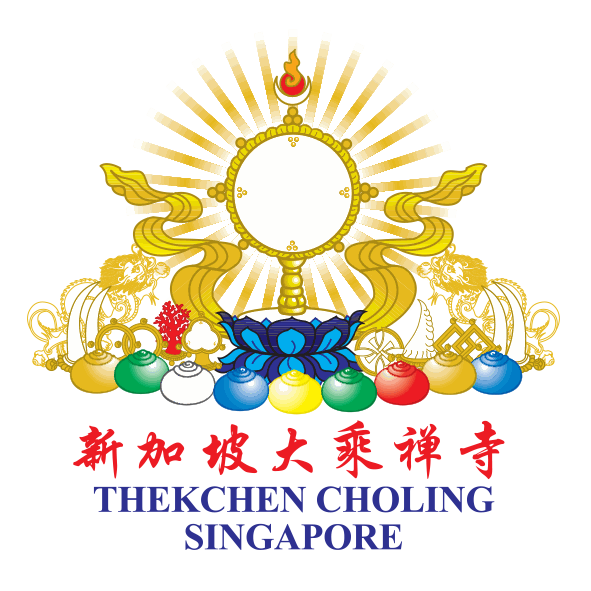
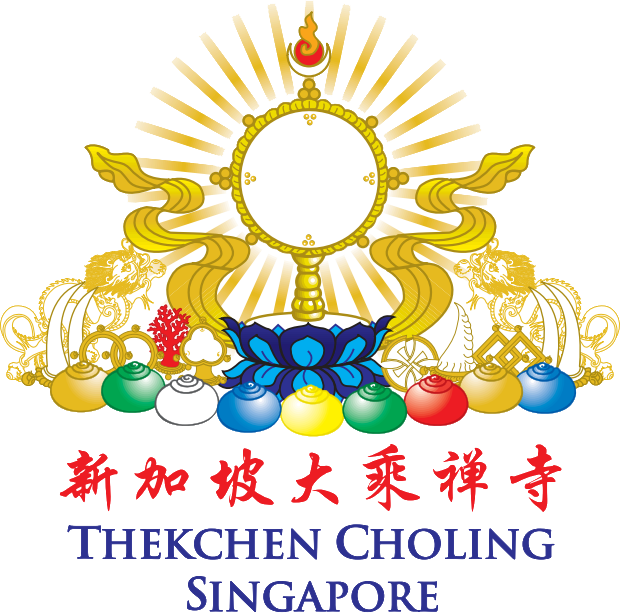
The Sacred Mirror represents consciousness and the element of space. Clear, pure and bright, the mirror reflects all phenomena objectively without bias, thereby reminding us to practice objectivity and to rise above our judgmental minds. On a more subtle level, it reflects the Buddha’s core teaching of emptiness – that nothing exists on its own side without a dependent arising cause.
Pinnacle of the mirror
The pinnacle of the mirror, formed by the white crescent moon, flaming red sun and an orange flame of fire, represents the completion stage of Vajrayana practice.
Light Rays
The light rays radiating from the Sacred Mirror represent the flourishing of the Buddha’s teachings, fanning out to the furthest reaches of the universe.
Full Moon Disc
The moon disc represents Bodhicitta, the aspiration to become a Buddha to benefit all sentient beings.
Blue Lotus
Divinely fragrant, blue lotuses bloomed only in the Buddha’s time. By incorporating it into the temple’s logo, it is symbolic of the ever-present Buddha in Thekchen Choling. Moreover, a lotus flower represents purity, perfection, compassion and renunciation, similar to how the beautiful lotus remains untainted even though it had arisen out from the muddy waters.
Nine Precious Jewels
These nine precious jewels represent the Guru, Buddha, Dharma, Sangha, yidam or mind-seal deity, Dharma protector, the sky, earth, and the human realm.
Two Dragons
The two dragons represent continuity and harmony and create the cause for the temple to enjoy the strong support of members and benefactors for Dharma to flourish.
Golden Khata
The flowing golden khata represents the auspicious increase of all Dharma activities.
The Seven Gems of the Chakravartin or a Wheel-Turning King
1. The precious horse represented by a unicorn’s horn
2. The precious elephant represented by its tusks
3. The precious queen represented by round golden earrings
4. The precious minister represented by square golden earrings
5. The precious general represented by a pair of crossed swords
6. The precious jewel represented by the triple-eyed gem
7. The precious Dharma wheel represented by a branch of coral