“The goal of refuge (in Buddha, Dharma, and Sangha), is to be in touch with all beings and to be awakened so that we can bring about the greatest benefit for all beings.”
Most people want to be sincere dharma practitioners, but only if nobody watches over them. If you have a Guru who tells you what to do (and not do), you are actually very fortunate – though you might not realize that. And if all you want to have is good luck, good health, and good family relationships, that’s okay. But if you practice correctly and with the right motivation, these things will come naturally to you as a side effect. These days it seems that these side effects – born out of ego – have sadly become our main and only focus.
The reason we cultivate dharma is to defeat our ego-self, not our self-confidence. The ego-self is the self-imputed self-importance that we have created. Nobody gave it to us. Being proud can have two different meanings. One is a sense of pride when you can cherish the skills that you have. The other one is when you have an egoistic pride. The egoistic pride comes from our concepts of the way we think things are. Everybody suffers from this in samsara.
The impediment to spiritual awakening is that drama is replacing dharma. Our mind picks up ‘drama’ because it takes no effort. It’s a karmic affinity thing because the moment you see it, it just clicks. So we must honestly reflect upon what we want in our lives. It is only our ignorance that prevents us from knowing this. With ignorance, we are overcome by our self-made concepts, and we don’t want to learn anything new or different from what supports those concepts to protect our ego.
Life coaches have become very popular recently because so many people are looking for someone to admire. But when it comes to a Guru, you need to find a Guru who is not a life coach but an enlightenment coach because even though we are learning dharma, we still don’t have the skills or realizations even to guide our current mind.
We take so many of these things for granted. It is challenging to practice dharma in places where you are surrounded by so many people who are only interested in this life’s immediate pleasures. If you decide to become awakened, don’t continue to give in to your excuses. We may be learning many new things, but that is not awakening.
So who wants enlightenment? Probably not people who are driven by ego and surface values. Perhaps only ones who have undergone deep experience; have used that suffering to strengthen and deepen their practice. They would want enlightenment and awakening.
Dharma Teaching by Singha Rinpoche and Edited by Sandeep Nath
29 Nov 2020
Sacred Mirror
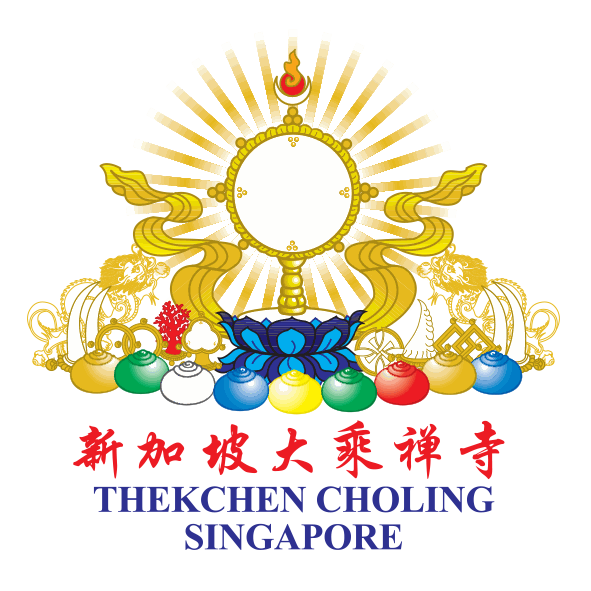
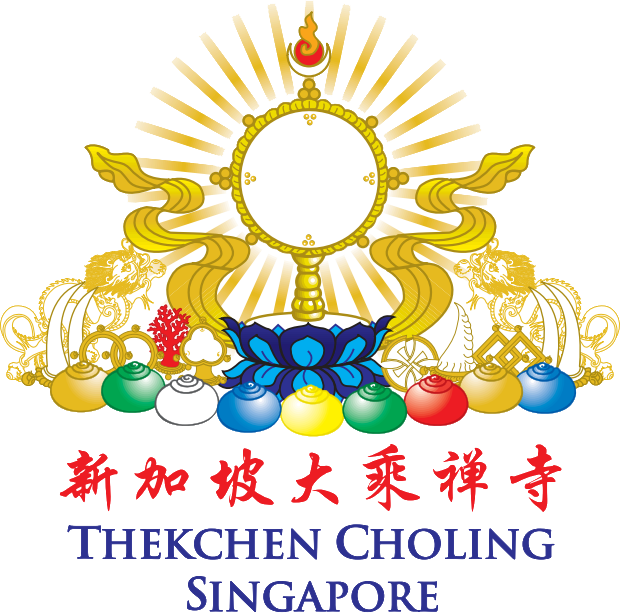
The Sacred Mirror represents consciousness and the element of space. Clear, pure and bright, the mirror reflects all phenomena objectively without bias, thereby reminding us to practice objectivity and to rise above our judgmental minds. On a more subtle level, it reflects the Buddha’s core teaching of emptiness – that nothing exists on its own side without a dependent arising cause.
Pinnacle of the mirror
The pinnacle of the mirror, formed by the white crescent moon, flaming red sun and an orange flame of fire, represents the completion stage of Vajrayana practice.
Light Rays
The light rays radiating from the Sacred Mirror represent the flourishing of the Buddha’s teachings, fanning out to the furthest reaches of the universe.
Full Moon Disc
The moon disc represents Bodhicitta, the aspiration to become a Buddha to benefit all sentient beings.
Blue Lotus
Divinely fragrant, blue lotuses bloomed only in the Buddha’s time. By incorporating it into the temple’s logo, it is symbolic of the ever-present Buddha in Thekchen Choling. Moreover, a lotus flower represents purity, perfection, compassion and renunciation, similar to how the beautiful lotus remains untainted even though it had arisen out from the muddy waters.
Nine Precious Jewels
These nine precious jewels represent the Guru, Buddha, Dharma, Sangha, yidam or mind-seal deity, Dharma protector, the sky, earth, and the human realm.
Two Dragons
The two dragons represent continuity and harmony and create the cause for the temple to enjoy the strong support of members and benefactors for Dharma to flourish.
Golden Khata
The flowing golden khata represents the auspicious increase of all Dharma activities.
The Seven Gems of the Chakravartin or a Wheel-Turning King
1. The precious horse represented by a unicorn’s horn
2. The precious elephant represented by its tusks
3. The precious queen represented by round golden earrings
4. The precious minister represented by square golden earrings
5. The precious general represented by a pair of crossed swords
6. The precious jewel represented by the triple-eyed gem
7. The precious Dharma wheel represented by a branch of coral