“We are all here to grow together and to help one another. In the human realm, what we need is to cultivate EQ, not just IQ, because it is EQ that makes things work.”
When we start practicing Buddhism, we encounter a lot of spiritual materialism. There is a collection of things, of prayers, of holy objects, and books. Later, when things start to settle down, we wonder why we are into all the practices. At times it feels that being spiritual is not helping us spiritually at all. And we question the purpose of it all.
In truth, it is the blessings of Guru and the Triple Gem that bring us to this question. No amount of holy objects or books, amulets or good luck charms, or Feng Shui fixes can make anybody happy or make life meaningful. This feeling is a sign of the ripening of one’s own past merits.
The purpose of our human life is to recognize that we are not just humans. You are not going to be a human being forever. And neither will you be your fixed self. You are here now and having this human experience as yourself. You are playing a role that is neither permanent nor fixed. The experiences you are having here are due to the kindness of others. And you are here to positively impact those who need your expertise, support, wisdom, words, thoughts, and generosity.
Our focus should be on whether our lives positively impact others and not live our lives to fulfill ourselves. We are not here to give anyone permanent happiness, so we must stop trying to do that, but we should do our best to bring some momentary happiness, joy, and serenity to others.
Lama Tsongkhapa said that the easiest way for ordinary beings to accumulate great merit is by rejoicing. Rejoice in the merits of both holy and ordinary beings. Rejoice in the benefits and the impact that they are bringing to other people’s lives. When we help someone, we are injecting a meaningful positivity into their life. Most of the things that we are enjoying now are because someone else shouldered the work for us, so always be grateful and appreciate it.
Most ordinary people want attention. They sometimes get it by behaving in negative ways, like creating drama or by overreacting to things. We don’t need to fault them. Instead, let us all be embracing and not judge anybody.
When we were growing up, our parents and grandparents might have told us that we were not good enough. Sometimes they could even have highlighted our inadequacies. The Guru is here to highlight all of the things we are good at to have a more balanced perception of ourselves. So the primary purpose of our practicing Buddhism is to realign ourselves repeatedly and with the right motivation and intention.
Dharma Teaching by Singha Rinpoche and edited by Sandeep Nath
6 Dec 2020
Sacred Mirror
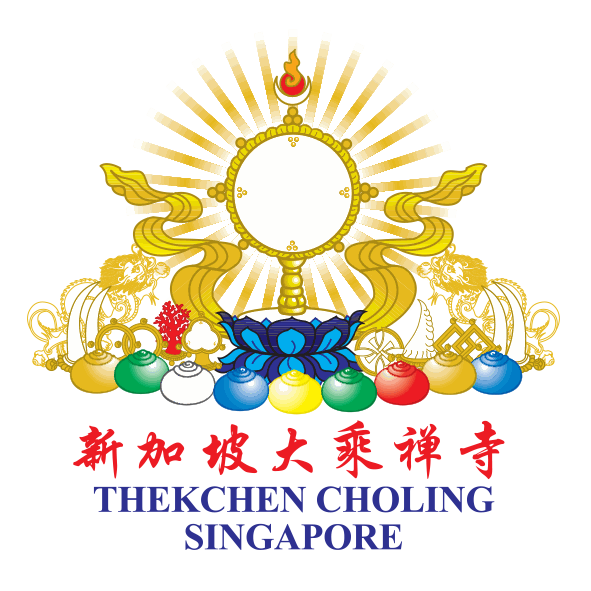
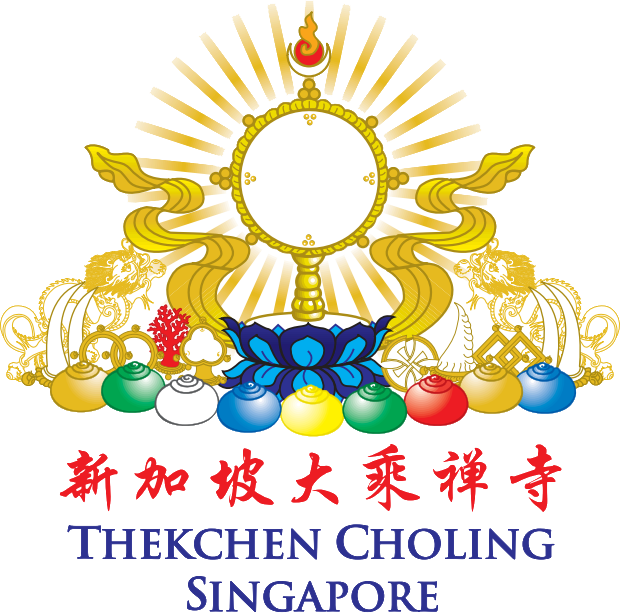
The Sacred Mirror represents consciousness and the element of space. Clear, pure and bright, the mirror reflects all phenomena objectively without bias, thereby reminding us to practice objectivity and to rise above our judgmental minds. On a more subtle level, it reflects the Buddha’s core teaching of emptiness – that nothing exists on its own side without a dependent arising cause.
Pinnacle of the mirror
The pinnacle of the mirror, formed by the white crescent moon, flaming red sun and an orange flame of fire, represents the completion stage of Vajrayana practice.
Light Rays
The light rays radiating from the Sacred Mirror represent the flourishing of the Buddha’s teachings, fanning out to the furthest reaches of the universe.
Full Moon Disc
The moon disc represents Bodhicitta, the aspiration to become a Buddha to benefit all sentient beings.
Blue Lotus
Divinely fragrant, blue lotuses bloomed only in the Buddha’s time. By incorporating it into the temple’s logo, it is symbolic of the ever-present Buddha in Thekchen Choling. Moreover, a lotus flower represents purity, perfection, compassion and renunciation, similar to how the beautiful lotus remains untainted even though it had arisen out from the muddy waters.
Nine Precious Jewels
These nine precious jewels represent the Guru, Buddha, Dharma, Sangha, yidam or mind-seal deity, Dharma protector, the sky, earth, and the human realm.
Two Dragons
The two dragons represent continuity and harmony and create the cause for the temple to enjoy the strong support of members and benefactors for Dharma to flourish.
Golden Khata
The flowing golden khata represents the auspicious increase of all Dharma activities.
The Seven Gems of the Chakravartin or a Wheel-Turning King
1. The precious horse represented by a unicorn’s horn
2. The precious elephant represented by its tusks
3. The precious queen represented by round golden earrings
4. The precious minister represented by square golden earrings
5. The precious general represented by a pair of crossed swords
6. The precious jewel represented by the triple-eyed gem
7. The precious Dharma wheel represented by a branch of coral