Finding the answer to everyday problems, and rediscover your place in the world.
When we give love, we expect to receive love in return, so how can we learn to practice unconditional love?
The answer to practicing unconditional love is found in the very same foundation for having a stable result in one’s entire dharma practice.
It’s also the same foundation in getting a result in one’s refuge, in The Three Principles of the Path and in Tantric practice.
My answer is from my own practice and experience and is in these three points:
Outwardly, do not be attached to things. We can use things but don’t become attached to them. Don’t let things become your burden. Always prepare to have things that are to be used, to be shared and to be given away without feeling attachment or heartache.
Inwardly, do not be attached to your body or anyone else’s body. Do exercise and maintain it to keep it healthy and working.
Secretly, do not be attached to your mind.After reflecting on and understanding these three points you can now give unconditional love. When you see someone who needs it, you just give it. Love is not a thing to become attached to, so give it freely. That’s my straight and to the point answer.
We must renounce the clinging, craving attachments we have to external things, to the body and to the mind. If you can’t renounce the attachment to the mind then you cannot dissolve your mind into the clarity of the right view of emptiness.With such a strong attachment to the identity of the human mind, we are not able to let ourselves go. Dharma is like the sandpaper or the sharpening stone that wears this identity attachment down. The ego itself is not real. The ego is just your many labels. But when your mind accepts something to be true, then it’s your ego that gets affected. All beings that are born are going to die. All of us are going to die. It’s really the scariest thing to us. That the identity and the body are going to die.
If we really digest Buddha’s teachings properly we would realize that kindness and compassion are the real qualities of Buddhism. In our practice this eventually leads us to realizations and then that hopefully leads us to wisdom. So when you say you are practicing Buddhism you should watch to be sure that you are not practicing “yourself”. When I say practicing “yourself” I mean that is when you are only practicing what you want to practice and only learning what you want to learn. But that is not practicing real dharma. Dharma is not like that. It is not something meant to be practiced only for your comfort. That is because dharma practice is really meant to turn you inside out.
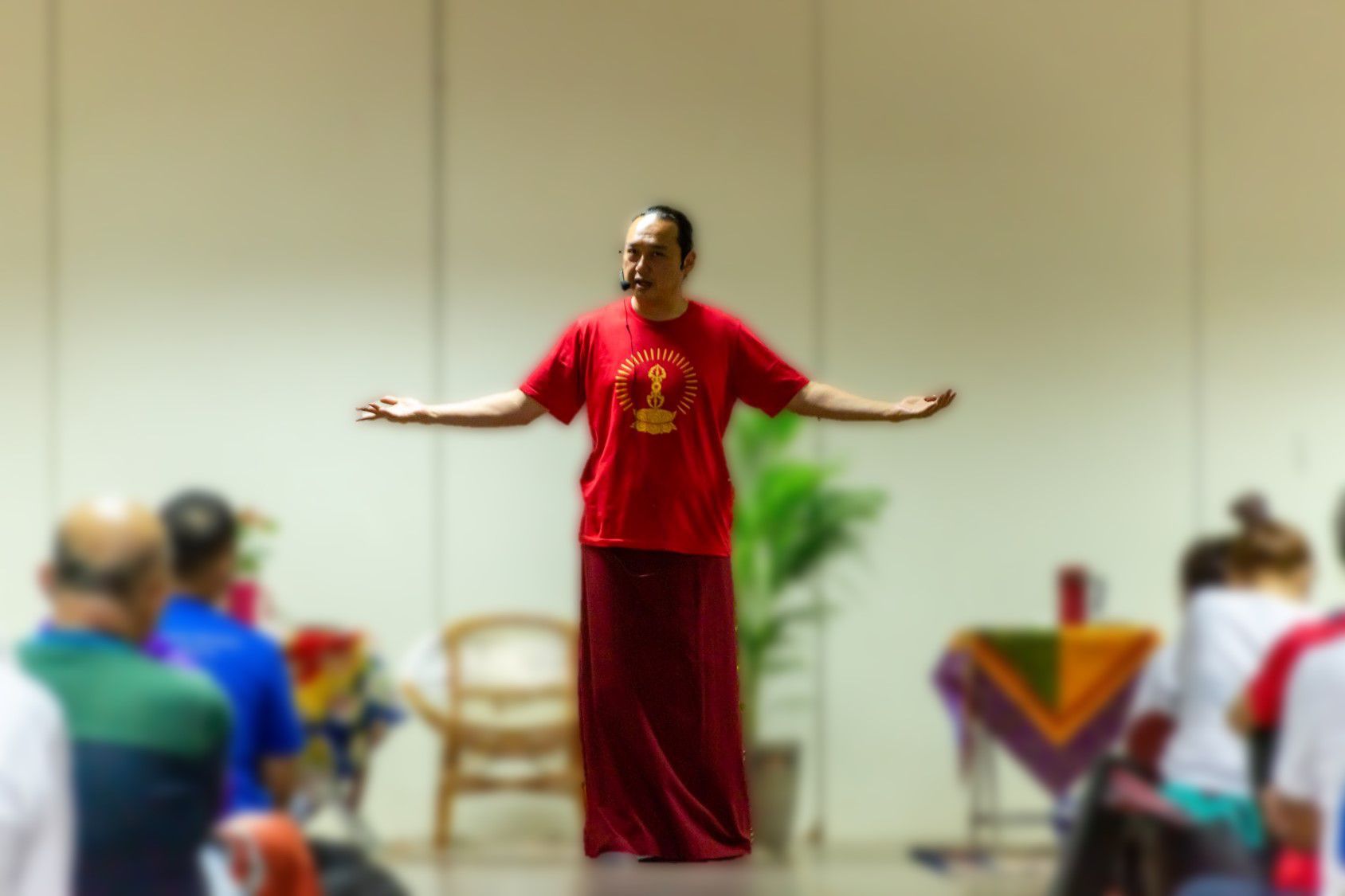
This advice was shared by Singha Rinpoche on the 10th October 2019, during the weekly Dharma Teaching
Dharma Wisdom
Sacred Mirror
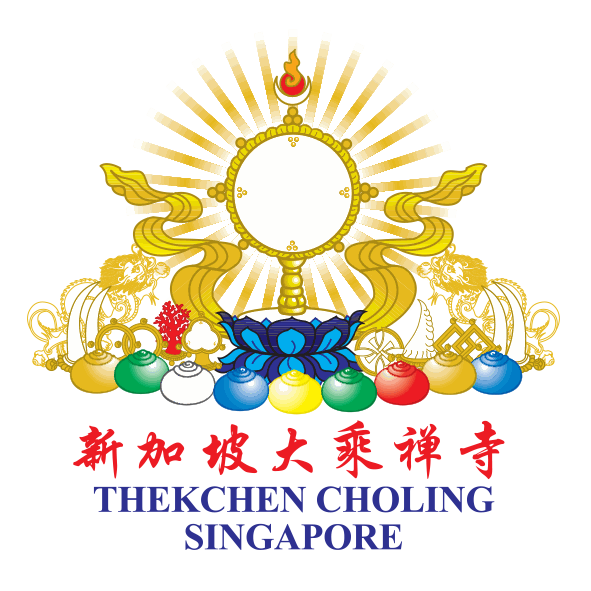
The Sacred Mirror represents consciousness and the element of space. Clear, pure and bright, the mirror reflects all phenomena objectively without bias, thereby reminding us to practice objectivity and to rise above our judgmental minds. On a more subtle level, it reflects the Buddha’s core teaching of emptiness – that nothing exists on its own side without a dependent arising cause.
Pinnacle of the mirror
The pinnacle of the mirror, formed by the white crescent moon, flaming red sun and an orange flame of fire, represents the completion stage of Vajrayana practice.
Light Rays
The light rays radiating from the Sacred Mirror represent the flourishing of the Buddha’s teachings, fanning out to the furthest reaches of the universe.
Full Moon Disc
The moon disc represents Bodhicitta, the aspiration to become a Buddha to benefit all sentient beings.
Blue Lotus
Divinely fragrant, blue lotuses bloomed only in the Buddha’s time. By incorporating it into the temple’s logo, it is symbolic of the ever-present Buddha in Thekchen Choling. Moreover, a lotus flower represents purity, perfection, compassion and renunciation, similar to how the beautiful lotus remains untainted even though it had arisen out from the muddy waters.
Nine Precious Jewels
These nine precious jewels represent the Guru, Buddha, Dharma, Sangha, yidam or mind-seal deity, Dharma protector, the sky, earth, and the human realm.
Two Dragons
The two dragons represent continuity and harmony and create the cause for the temple to enjoy the strong support of members and benefactors for Dharma to flourish.
Golden Khata
The flowing golden khata represents the auspicious increase of all Dharma activities.
The Seven Gems of the Chakravartin or a Wheel-Turning King
1. The precious horse represented by a unicorn’s horn
2. The precious elephant represented by its tusks
3. The precious queen represented by round golden earrings
4. The precious minister represented by square golden earrings
5. The precious general represented by a pair of crossed swords
6. The precious jewel represented by the triple-eyed gem
7. The precious Dharma wheel represented by a branch of coral