Blog Post 35: When the Why is clear, all answers appear
“Before answering the question of how to practice dharma we should be able to answer the question of why we are practicing.”
Will practicing Buddhism automatically make you a Buddha? No, it will not. For us to reach Buddhahood we must find a way to overcome our own mindset and this is why we take refuge. We each have our own karmic dispositions and we each have our own workable methods to keep our sanity. But we must see that we also need to suffer in order for us to find out our own “why”.
We are taught that things happen. We look at all of the happenings all around us but what is happening is really based upon each individual’s view and experience. Things don’t just happen to us; things manifest for us. The seeds come to us from our own karma. The choice of our reaction or our response to situations is also based upon our own karma. How one chooses to view things is really due to one’s karmic level. That is why it is so important for us to do daily purification practices, which are the foundation of all Buddhist practices. If we don’t purify our own karma then we will always be reacting in certain ways or in patterns that don’t necessarily allow us to create the shift that changes the gears that we need to change.
Why you feel you want to make this change, and why you want to study the dharma and why you want to make an internal shift, are all questions only you can answer because nobody else can answer your “whys”.
We need to have discipline to subdue our minds from our own thoughts. We take vows for the purpose of maintaining this discipline, we aspire to concentration and then we cultivate towards the awakening of wisdom. From discipline we cultivate steadfastness or concentration. From concentration we generate the result of wisdom. The purpose of these three; discipline, concentration and wisdom, is for us to overcome our own self-propelled idea of view. With self and identity and ego there is always going to be wrong views because we think that everything must suit the way that we think in order for it to be right. The vows that we take to maintain discipline also help us to create merit. Without vows, without merit, without purification, and without discipline we cannot have concentration and so then we cannot have the result of wisdom.
Whether you think you have good karma or bad karma, it only means that you are looking at it according to your own ideal. Shift your gears beyond what’s good or bad. Those who fall victim to only your own ideology or only to other people’s ideology of what is good or what is bad will fail to produce any results. So, don’t think so much about what’s good or bad. Instead, think about what is the most beneficial. And all other things will fall in place.
Dharma Teaching by Singha Rinpoche and edited by Sandeep Nath
9 May 2021
Sacred Mirror
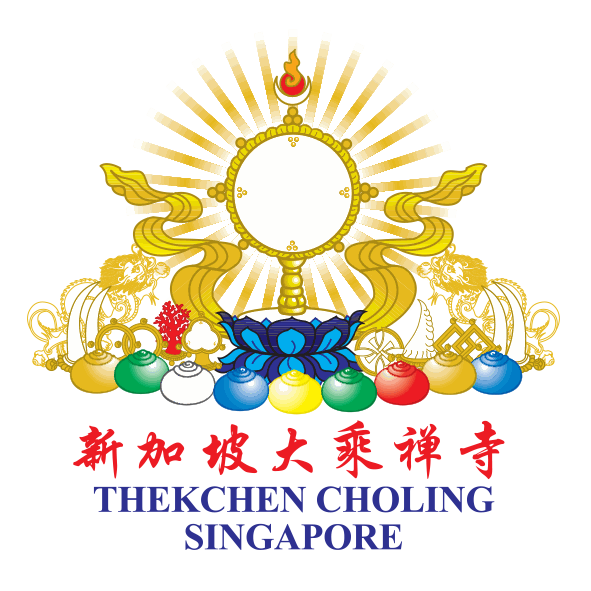
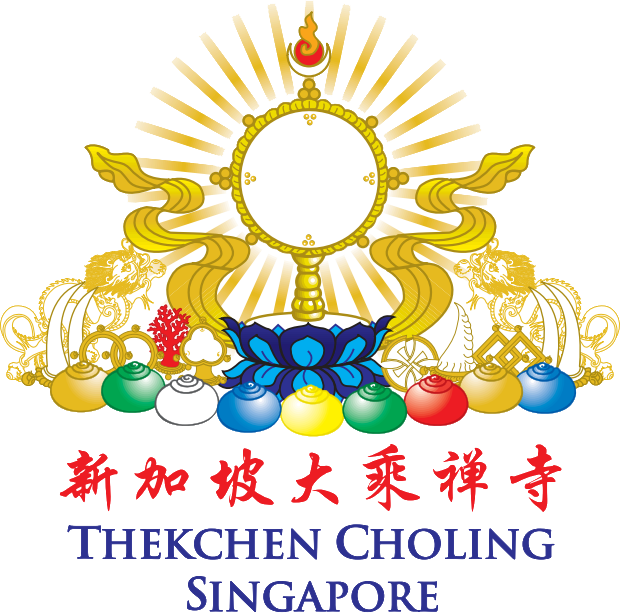
The Sacred Mirror represents consciousness and the element of space. Clear, pure and bright, the mirror reflects all phenomena objectively without bias, thereby reminding us to practice objectivity and to rise above our judgmental minds. On a more subtle level, it reflects the Buddha’s core teaching of emptiness – that nothing exists on its own side without a dependent arising cause.
Pinnacle of the mirror
The pinnacle of the mirror, formed by the white crescent moon, flaming red sun and an orange flame of fire, represents the completion stage of Vajrayana practice.
Light Rays
The light rays radiating from the Sacred Mirror represent the flourishing of the Buddha’s teachings, fanning out to the furthest reaches of the universe.
Full Moon Disc
The moon disc represents Bodhicitta, the aspiration to become a Buddha to benefit all sentient beings.
Blue Lotus
Divinely fragrant, blue lotuses bloomed only in the Buddha’s time. By incorporating it into the temple’s logo, it is symbolic of the ever-present Buddha in Thekchen Choling. Moreover, a lotus flower represents purity, perfection, compassion and renunciation, similar to how the beautiful lotus remains untainted even though it had arisen out from the muddy waters.
Nine Precious Jewels
These nine precious jewels represent the Guru, Buddha, Dharma, Sangha, yidam or mind-seal deity, Dharma protector, the sky, earth, and the human realm.
Two Dragons
The two dragons represent continuity and harmony and create the cause for the temple to enjoy the strong support of members and benefactors for Dharma to flourish.
Golden Khata
The flowing golden khata represents the auspicious increase of all Dharma activities.
The Seven Gems of the Chakravartin or a Wheel-Turning King
1. The precious horse represented by a unicorn’s horn
2. The precious elephant represented by its tusks
3. The precious queen represented by round golden earrings
4. The precious minister represented by square golden earrings
5. The precious general represented by a pair of crossed swords
6. The precious jewel represented by the triple-eyed gem
7. The precious Dharma wheel represented by a branch of coral